 |
The European Public Health Association Newsletter – April 2021 |
1. Editorial
It is our pleasure to update you in this April newsletter with updates on EUPHA, our members, the European Public Health Week, interesting publications, conferences and the latest news from ECDC, European Commission and WHO Regional office for Europe.
Wishing you pleasant reading,
Iveta Nagyova, EUPHA president and Dineke Zeegers Paget, EUPHA executive director
|
2. EUPHA update
EUPHA Working group on gender equality and Women Empowerment
On International Women’s Day, the formation was anounced of a new Working Group (WG) at EUPHA – European Public Health Association. The WG on #GenderEquality and on Women’s Empowerment will focus on capturing the perspectives of all EUPHA Sections to comprehensively map the needs, the priorities and key actioning areas in European and global public health to achieve gender equality and empower all women and girls, and meet the United Nations #SDG5. #EUPHA4SDG5 #IWD2021 #WomenInLeadership Mindful of the need to support gender equality and the empowerment of all women, we aim to develop a comprehensive strategy to be released in April 2021. We welcome the input and the involvement of EUPHA members and of everyone active in European and global public health, or in related efforts across sectors.
New EUPHA Law and public health section (EUPHA-LAW)
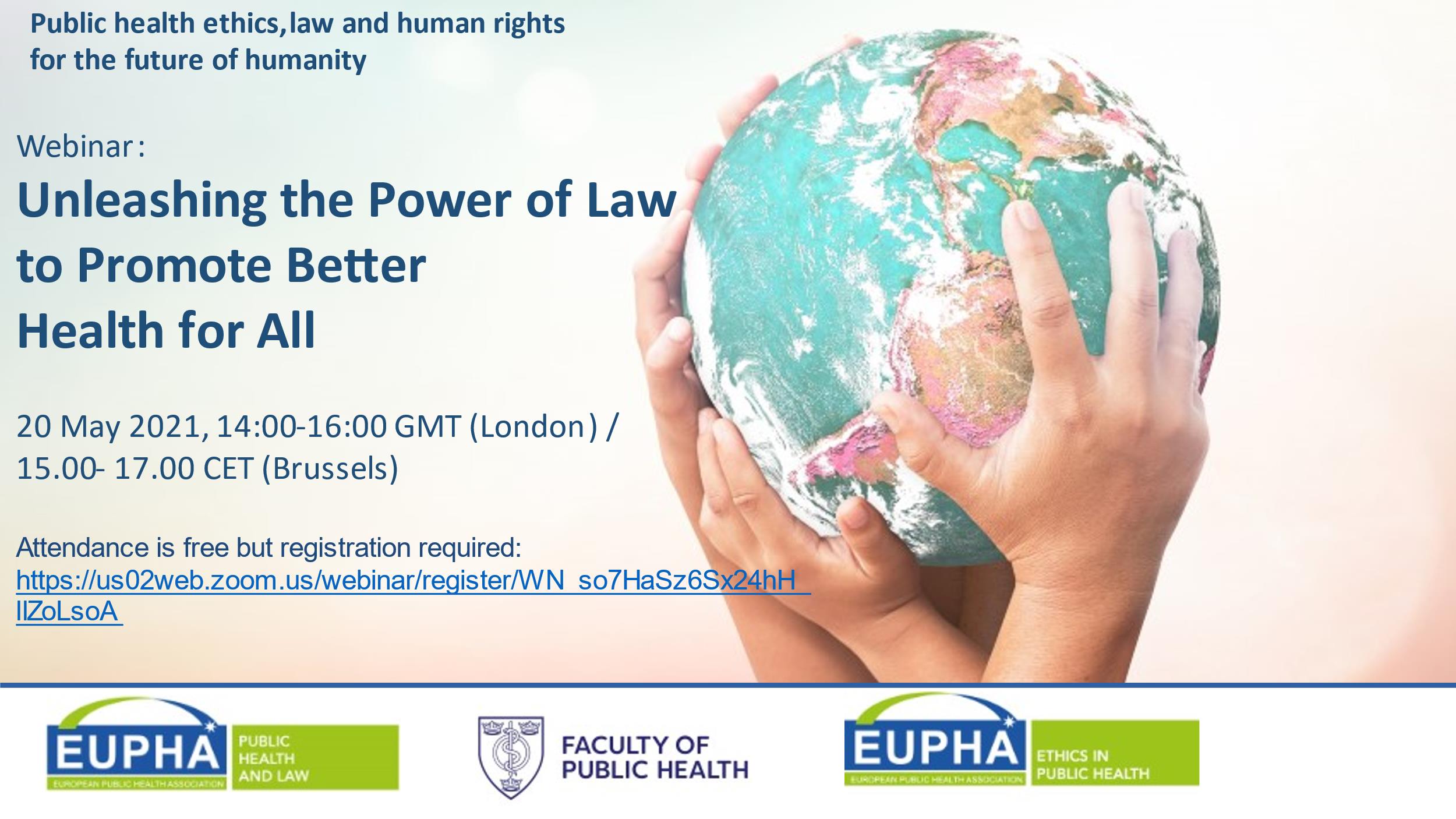
There is a growing recognition that law as a discipline has a major role to play in framing effective public health strategies and interventions to promote and prevent public’s health. To respond to this, EUPHA has established a new Law and public health section (https://eupha.org/law-and-public-health). Professor Amandine Garde (University of Liverpool) has been elected as President of the section. The section will be launched on 20th May 2021, 15.00 to 17.00 CEST (Brussels time).
Webinar: Unleashing the Power of Law to Promote Better Health for All
When: Thursday, 20th May 2021, at 14.00- 16.00 BST (London) / 15.00 – 17.00 CEST (Brussels)
https://us02web.zoom.us/webinar/register…
EUPHA joins the Beating Cancer Stakeholder Group
EUPHA has joined the Beating Cancer Stakeholder Contact Group on the Health Policy Platform. The working group will likely focus on the four pillars of the Plan, and will support its implementation. We are looking forward to the many fruitful discussions with other network members.
European Journal of Public Health goes for Open Access
EUPHA’s scientific journal – the European Journal of Public Health – will go fully Open Access as of 1 January 2022. In order to prepare for this change, the Open Access fee will apply to all articles submitted on or after the 1st of June 2021 (if accepted for publication). More information will be available soon at: https://academic.oup.com/eurpub
|
3. European Public Health Week
Submit your event by 5 May
You still have a few days to share your activity here to ensure it’s listed on the EUPHW calendar for others to join you.
Mark your diaries with other EUPHW events
|

4. European Public Health Conference
14TH EUROPEAN PUBLIC HEALTH CONFERENCE, 10 – 12 NOVEMBER 2021 – VIRTUAL EDITION
Public health futures in a changing world
1 MAY: LAST DAY TO SUBMIT YOUR ABSTRACT!
REGISTRATION BENEFITS FOR EUPHA MEMBERS
UPDATE ON THE PLENARY SESSION ORGANISED BY EUPHA
PLENARY PROGRAMME
PARALLEL PROGRAMME |
5. EUPHA members update
New board members at the Serbian Public Health Association
|
6. European Journal of Public Health
Volume 31, Issue 2, April 2021
EDITORIALS
The legacy of an ideology: a decade on from benefits as lifestyle choice
HEALTH SERVICES RESEARCH
Public support for European cooperation in the procurement, stockpiling and distribution of medicines
The role of motivational and legal contexts in understanding support for tissue donation across 27 European countries
MIGRATION
Migration or ethnic minority status and risk of autism spectrum disorders and intellectual disability: systematic review
Development and validation of a questionnaire to assess Unaccompanied Migrant Minors’ needs (AEGIS-Q)
Home and away: mortality among Finnish-born migrants in Sweden compared to native Swedes and Finns residing in Finland
Infant mortality among native-born children of immigrants in France, 2008–17: results from a socio-demographic panel survey
The association between migration and smoke-free families: how do migrants from different world regions compare?
CANCER PREVENTION
Inequalities and risk factors related to non-participation in colorectal cancer screening programmes: a systematic review
Efforts needed for preventing breast and colorectal cancer through changes in dietary patterns
Association between health literacy and colorectal cancer screening behaviors in adults in Northwestern Turkey
OBESITY/PHYSICAL ACTIVITY
Trends in active commuting to school from 2003 to 2017 among children and adolescents from Germany: the MoMo Study
Psychosocial health of adolescents in relation to underweight, overweight/obese status: the EU NET ADB survey
Exposure to multiple childhood social risk factors and adult body mass index trajectories from ages 20 to 64 years
Identifying the views of adolescents in five European countries on the drivers of obesity using group model building
Mid-adolescent ethnic variations in overweight prevalence in the UK Millennium Cohort Study
TOBACCO
Mixed evidence for the compression of morbidity hypothesis for smoking elimination—a systematic literature review
ALCOHOL
Trends in adolescent drinking across 39 high-income countries: exploring the timing and magnitude of decline
A scoping review of qualitative research on perceptions of one’s own alcohol use
SUBSTANCE USE
Correlates of patterns of cannabis use, abuse and dependence: evidence from two national surveys in Ireland
BOOK REVIEW
EUROPEAN PUBLIC HEALTH NEWS
https://academic.oup.com/eurpub/issue/31…
|
7. Call for proposals, job opportunities
DIGNITY is looking for a Post Doc (2 years)
Would you like contribute to a unique project were your time will be divided between Denmark and several other countries? And do you have a Ph.D., and the will to contribute to the important work at DIGNITY? |
8. Interesting news
Coronavirus Politics: The Comparative Politics and Policy of COVID-19
This book identifies key threads in the global comparative discussion that continue to shed light on COVID-19 and shape debates about what it means for scholarship in health and comparative politics.
The Sex, Gender and COVID-19 Health Policy Portal
The Sex, Gender and COVID-19 Health Policy Portal offers the most comprehensive review of the recognition of and response to sex and gender in national COVID-19 public health policies globally. It collates and reviews over 450 policies and policy excerpts from 76 countries across all WHO regions and World Bank income groups.
Burned out by the pandemic, 3 in 10 health-care workers consider leaving the profession
‘It’s not just the danger they’ve endured, they say. Many talked about the betrayal and hypocrisy they feel from the public they have sacrificed so much to save — their clapping and hero-worship one day, then refusal to wear masks and take basic precautions the next, even if it would spare health workers the trauma of losing yet another patient.’
World Health Organization recognises LSHTM’s expertise on climate change and health
Research into climate change and health has been significantly strengthened thanks to a new partnership between the London School of Hygiene & Tropical Medicine’s Centre on Climate Change and Planetary Health (CCCPH) and the World Health Organization (WHO).
What we’re getting wrong in the conversation about mental health
The Guardian | Opinion
Public Health Ethics Reading Groups
The COVID-19 pandemic has raised many ethical issues pertaining to public health emergencies and further raised the profile and importance of public health ethics.
|
9. Upcoming courses and conferences
|
10. Interesting publications
Using the COVID-19 pandemic to reimagine global health teaching in high-income countries
The BMJ | Editorial | 1 April 2021
Health of women and children is central to COVID-19 recovery
The BMJ | Analysis | 14 April 2021
The potential impact of the COVID-19 pandemic on global antimicrobial and biocide resistance: an AMR Insights global perspective
JAC-Antimicrobial Resistance | 8 April 2021
Effect of socioeconomic inequalities and vulnerabilities on health-system preparedness and response to COVID-19 in Brazil: a comprehensive analysis
The Lancet Global Health | Analysis | 12 April 2021
Views of health professionals on climate change and health: a multinational survey study
The Lancet Planetary Health | Viewpoint | 7 April 2021
Children in All Policies 2030: a new initiative to implement the recommendations of in All Policies 2030: a new initiative to implement the recommendations of the WHO-UNICEF-Lancet Commission
On April 21, 2021, the Children in All Policies 2030 (CAP-2030) was launched, with the support of WHO, UNICEF, and The Lancet. Its ambition is to join its voice to those of children and young people, activists, civil society institutions, religious groups, UN organisations, politicians, governments, private sector leaders, academics, and others working to centre children’s health and wellbeing in the urgent work of sustainable development.
Public health competences through the lens of the COVID-19 pandemic: what matters for health workforce preparedness for global health emergencies?
Katarzyna Czabanowska, Ellen Kuhlmann
Editorial: Global health and health workforce development: what to learn from COVID-19 on health workforce preparedness and resilience?
Ellen Kuhlmann, Gilles Dussault, Tiago Correia
Prioritizing people and rapid learning in times of crisis: a virtual learning initiative to support health workers during the COVID-19 pandemic
Beth Engelbrecht, Lucy Gilson, Pierre Barker, Krish Vallabhjee, Gareth Kantor, Mike Budden, Anita Parbhoo, Uta Lehmann |
11. European Commission news
Joint Statement on European Immunization Week 2021: Celebrating the past, present and future benefits of vaccines
On the occasion of European Immunization Week 2021, Stella Kyriakides, Commissioner for Health and Food Safety, Hans Henri P. Kluge, Regional Director, World Health Organization (WHO) Regional Office for Europe, and Afshan Khan, Regional Director for Europe and Central Asia, United Nations Children’s Fund (UNICEF), made a joint statement.
Further crucial step for the Digital Green Certificate: Member States agree on technical specifications
The agreed technical specification covers data structure and encoding mechanisms, describes the EU gateway, and describes reference implementations for software to issue Digital Green Certificates.
Mental health and the pandemic: registration open for European Commission event
Registration is now open to hear the voice of those affected, including people with pre-existing mental health problems and those providing care. Whilst policies and services addressing mental health are the responsibility of individual EU countries, this event will share examples and promising practices, exploring what we know and what we need to understand better, and discuss how to ensure that our health systems are well enough equipped, today and in the future.
Register now for the 10 May European Commission event: Mental health and the pandemic: living, caring, acting!
What does it mean to live in a world defined by COVID-19 and to provide care in this pandemic age? Plan to attend this virtual event, hosted by Commissioner Kyriakides, on 10 May 2021 to gain a better understanding of the mental health impact of COVID-19. The event will bring together a wide array of speakers, including representatives from EU countries, the European Commission, European Parliament as well as from patient organisations, non-governmental organisations, health professionals, civil society and international organisations. The conference language will be English. |
12. European Centre for Disease Prevention and Control news
EMA and ECDC join forces for enhanced post-marketing monitoring of COVID-19 vaccines in Europe
The European Medicines Agency (EMA) and the European Centre for Disease Prevention and Control (ECDC) kicked off a new initiative aimed at strengthening post-marketing monitoring of the safety, effectiveness and impact of COVID-19 vaccines in the EU/EEA.
Eurosurveillance – Volume 26, Issue 13, 01 April 2021
Rapid communication
Eurosurveillance – Volume 26, Issue 14, 08 April 2021
Outbreaks
Eurosurveillance – Volume 26, Issue 15, 15 April 2021
Rapid communication
COVID-19 vaccines
To celebrate the European Immunization Week, the ECDC has created a new COVID-19 collection that will be updated weekly, as they publish new articles on the topic.
Eurosurveillance – Volume 26, Issue 16, 22 April 2021
Rapid communication |
13. WHO news
Statement for EIW 2021 – This week we celebrate the role of vaccines in bringing us closer
European Immunization Week this year is like no other we have celebrated before. Today we are in the midst of an unprecedented COVID-19 vaccine rollout across the world that offers us optimism that “vaccines will bring us closer” again.
Institutionalizing health technology assessment mechanisms: a how to guide
The WHO is increasingly supporting countries to develop institutionalised health technology assessment mechanisms to support decision making about which interventions to reimburse for universal health coverage benefit packages. This guidance note provides checklists to support implementation in each chapter.
Spending on health in Europe: entering a new era
This report analyses health spending in 53 countries in the WHO European Region from 2000 to 2018 (the latest year for which internationally comparable data are available). It reviews key patterns and trends in health spending over time and across countries in 5 different areas.
New report from WHO on health spending calls on governments not to repeat past mistakes when rebuilding from COVID-19
A new report from the WHO Barcelona Office for Health Systems Financing has highlighted the need for governments to maintain a higher level of public spending on health for the wider benefit of society despite expected budgetary pressures following the pandemic.
United action for stronger quality of care in the European Region – WHO supports Greece in building a national health system for the 21st century
During his visit to Greece, WHO’s Regional Director for Europe, Dr Hans Henri P. Kluge, opened a new centre of excellence in Athens focusing on quality of care and patient safety.
Using the arts to improve health: WHO pioneers large-scale, arts-based health interventions
A new partnership project initiated by WHO/Europe and the Nordic Culture Fund sets out to explore effective and sustainable strategies for integrating arts and culture into the wider health-care sector. Led by WHO/Europe’s flagship unit on behavioural and cultural insights for health, it will bring together academics, artists, cultural institutions, health-care practitioners and policy-makers from different countries.
WHO, FAO, and OIE call for stronger coordination in mitigating health threats
In a joint statement, the Food and Agriculture Organization of the United Nations (FAO), the World Organisation for Animal Health (OIE) and WHO, committed to strengthening multisectoral coordination and efforts to combat health threats associated with interactions between humans, animals and the environment across Europe and Central Asia.
Frontline stories: mental health of health care workers in the COVID-19 pandemic
A short film produced by the WHO Regional Office for Europe shows health care workers talking about the mental health and well-being challenges they have been facing while caring for patients during the COVID-19 pandemic.
Designing cities for health: how to change urban environments for the better?
Living in cities has been linked to higher exposure to pollution, lack of physical exercise, and a resulting increase in noncommunicable diseases. However, innovations in urban design can reverse this trend and show how cities can make people’s health better. |
|
This newsletter received co-funding under an operating grant from the European Union’s Health Programme (2014-2020). The content of this newsletter represents the views of the author(s) only and is his/her sole responsibility; it cannot be considered to reflect the views of the European Commission and/or the Consumers, Health, Agriculture and Food Executive Agency or any other body of the European Union. The European Commission and the Agency do not accept any responsibility for use that may be made of the information it contains.
|
|
Unsubscribe
If you would like unsubscribe from the EUPHA newsletter then please click here.
|