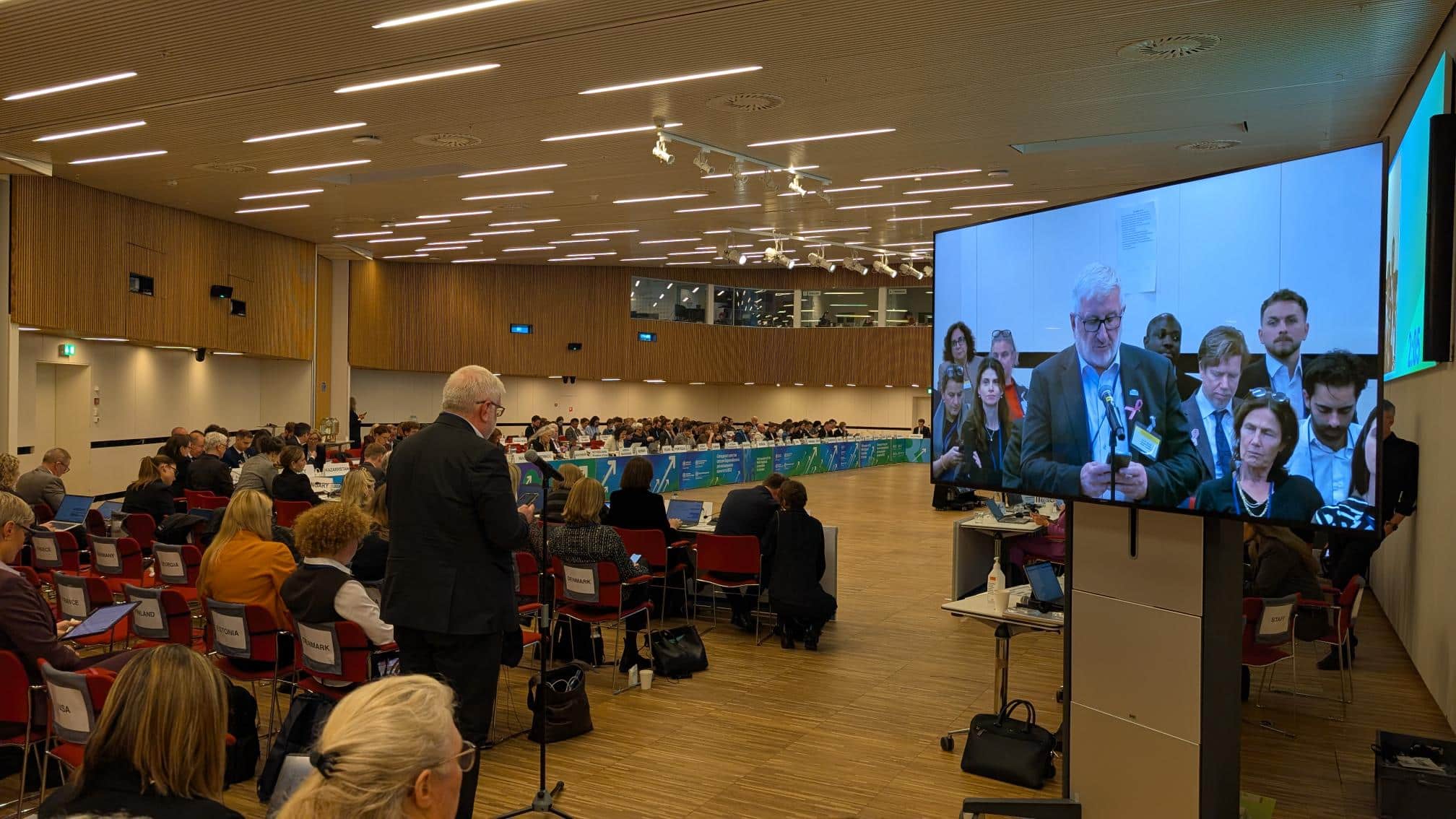
Europe’s health strategies depend on the people and institutions that put them into practice. Today, Tit Albreht, President of EUPHA, delivered a joint statement on behalf of EUPHA, ASPHER and fellow non-state actors at the 76th session of the WHO Regional Committee for Europe, calling for stronger investment in public health education, training and professional recognition.
The statement highlights a shared requirement across priorities including healthy ageing, artificial intelligence, mental health and noncommunicable diseases: a public health workforce equipped to turn evidence and policy into action.
Building on progress since last year’s Regional Committee, the signatories urge Member States to make workforce education and institutional capacity central to their health strategies, backed by dedicated funding. They also call for recognition of public health professionals’ qualifications and continuing learning, nationally and across Europe, strengthening career pathways and the workforce’s collective voice.
The statement brings together seven organisations: the European Public Health Association (EUPHA); the Association of Schools of Public Health in the European Region (ASPHER); the European Independent Foundation in Angiology/Vascular Medicine (VAS); EuroHealthNet, the European Partnership for Improving Health, Equity and Wellbeing; the European Federation of Allergy and Airways Diseases Patients’ Associations (EFA); the European Federation of Psychologists’ Associations AISBL (EFPA); and the European Public Health Alliance (EPHA).
Full statement:
76th Session of the WHO Regional Committee for Europe
Agenda item: General discussion on the addresses by the Director-General and the Regional Director
Joint statement
Dear Chair, Regional Director, esteemed ministers and distinguished delegates,
The European Public Health Association (EUPHA) and the Association of Schools of Public Health in the European Region (ASPHER), together with the co-signatory Non-State Actors, welcome the direction set out in the addresses by the Director-General and the Regional Director, and the three strategies that will be presented before this Committee: Ageing is living, the roadmap for action on artificial intelligence in health, and the work toward a strategy on noncommunicable diseases and health promotion 2027–2037. We also support the proposal for a complementary regional strategy on mental health and well-being.
These strategies address different challenges, but they share one condition for success: a public health workforce trained and able to deliver them.
This workforce delivers the twelve essential public health functions through an enabling institutional ecosystem. It spans people and organisations working in communities, municipalities, prevention services, public health institutes and agencies, civil society organisations, ministries, schools and research institutes; and includes core public health personnel, health and care workers and occupations allied to health. Every strategy this Committee adopts lands on these same people and institutions. What they learn, and their capacity to act together, should count.
At the 75th session, we asked this Committee to invest in the training, continuous learning and representation of this workforce. One year on, we can report progress, and we come with more precise requests.
We have acted, in cooperation with WHO Europe, and across these same priorities. On ageing, we contributed to the WHO Europe leadership course on healthy ageing, bringing a serious game-learning approach to build systems-thinking competences among public health leaders. On mental health, with WHO Europe and funding from the European Commission, ASPHER developed a competency framework to address the mental health crisis, and EUPHAcademy launched Strengthening Public Health Workforce Capacity for Mental Health Promotion and Prevention for professionals from the EU, Iceland and Norway. On artificial intelligence and digital health, on preparedness, security and resilience, and on Health in All Policies, we are building the initial and continuing education that public health professionals require, structuring a core curriculum in public health for Europe, and accrediting against internationally recognised standards, so that what is learned counts beyond the course.
This is how we understand our role. Beyond supporting WHO and disseminating its work, we help ensure that the public health professionals and organisations inour networks are equipped to adapt WHO guidance to their own context and implement it. This requires both individual competence and a wider public health system able to translate evidence into action, work across sectors, engage communities and support accountability. From our standpoint, this is the essence of complementarity and cooperation.
With WHO Europe, the WHO–ASPHER roadmap and the global competency and outcomes framework for the essential public health functions are our common reference, and schools of public health and professional associations are already delivering alongside you. This should also recognise and support the institutional capacity of public health institutes, professional associations and civil-society organisations that enable these functions to be delivered in practice. It is imperative to continue to reinforce and deepen this work. We therefore call on Member States to make workforce education and institutional capacity core pillars of each of these strategies, with dedicated funding for continuous, collective and evidence-based training and for the institutions through which public health functions are delivered; to recognise the learning pathways of public health professionals nationally and across Europe, including qualifications and micro-credentials; and to use the roadmap and the global competency and outcomes framework for the essential public health functions as the reference for national workforce plans. Recognition is what turns investment in capacity building into better quality of services and into careers with prospects.
When public health professionals learn together, from the best available evidence and with sound pedagogy, they build competences aligned with these frameworks. They gain qualifications that employers and authorities can recognise and certify. And they form a shared identity that lets them speak for their field. EUPHA and ASPHER (and the co-signatories of this statement) are committed to continue to work together on the European public health workforce agenda, rooted in practice and research evidence, complementing and amplifying existing frameworks, and listening to the needs so that the whole public health community is equipped on solid, robust and consistent foundations, for the careers of its professionals and for their impact on the challenges of today and tomorrow. Together, education, recognition and institutional capacity equip the whole public health community on solid, robust and consistent foundations, strengthening both professional careers and their impact on the challenges of today and tomorrow.
VAS-int is an organisation rooted in vascular medicine (where vascular diseases and patients’ needs still call for greater recognition, attention and action) and guided by a broad, integrated vision of health, translating its commitment to education as the foundation of sustainable progress, public health as a shared asset built on equity and quality, and genuine collaboration as a driving force for lasting impact into concrete European and international action—through advanced specialist education (European Master programmes, courses, books and publications), health literacy and patient engagement (EU Vascular Month, EU Patient Network), and initiatives strengthening education and responsibility among healthcare professionals—connecting specialist expertise with broader public health priorities in support of WHO objectives, while advocating stronger coordination to turn shared principles into sustainable results. We strongly support this statement and believe that stronger cooperation across public health organisations and specialist medical organisations would be highly desirable to advance these shared goals.
Thank you.
Copenhagen, October 2026
Signatories:
- EUPHA European Public Health Association
- ASPHER Association of Schools of Public Health in the European Region
- VAS European Independent Foundation in Angiology/Vascular Medicine,
- EuroHealthNet – European Partnership for Improving Health, Equity and Wellbeing,
- EFA – European Federation of Allergy and Airways Diseases Patients’ Associations
- European Federation of Psychologists’Associations AISBL (EFPA)
- European Public Health Alliance (EPHA)