 |
The European Public Health Association Newsletter – April 2023 |
1. Editorial
This April edition of the EUPHA Newsletter is the last edition before the European Public Health Week! Do not miss out on the opportunity to get involved: check out the item on the Week below for more information. Furthermore, in this Newsletter we welcome a new EUPHA member from Portugal and share several updates on EUPHA activities, including a visit by EUPHA’s strategic advisor Dineke Zeegers to Latvia. Among other things, Dineke visited the Institute of Public Health there. And as usual, you can find in this Newsletter updates and interesting news from WHO, the European Commission and other European institutes, and our wider network.
Enjoy the read!
Iveta Nagyova, EUPHA president and Marieke Verschuuren, Executive Director
|
2. EUPHA update
New EUPHA member: Portuguese Society of Public Health
We warmly welcome new full member, the Portuguese Society of Public Health, to the EUPHA network. We look forward to a fruitful collaboration.
EUPHA supports European Citizens’ Initiative to achieve 1st tobacco-free generation
Tobacco still is a major cause of – preventable – death and disease. Therefore, EUPHA supports this European Citizens’ Initiative, which calls to:
Join us in supporting this call. As a European Citizen you can use your right as defined by the EU Constitution to make a change for you, for your loved ones and for the next generation. By signing this initiative you could actively contribute to a healthy population, a healthy environment, a healthy Europe.
Progress report – Climate Action pledge
Sustainability Mission: EUPHA is dedicated to environment and health issues in all activities and action, especially through EUPHA Conferences and European Public Health week activities. EUPHA seeks to advocate for targeted climate action using evidence-based policies. Going beyond business-as-usual activities to address climate change through targeted discussions, workshops and meetings for medical professionals.
EUPHA’s strategic advisor in Riga, Latvia
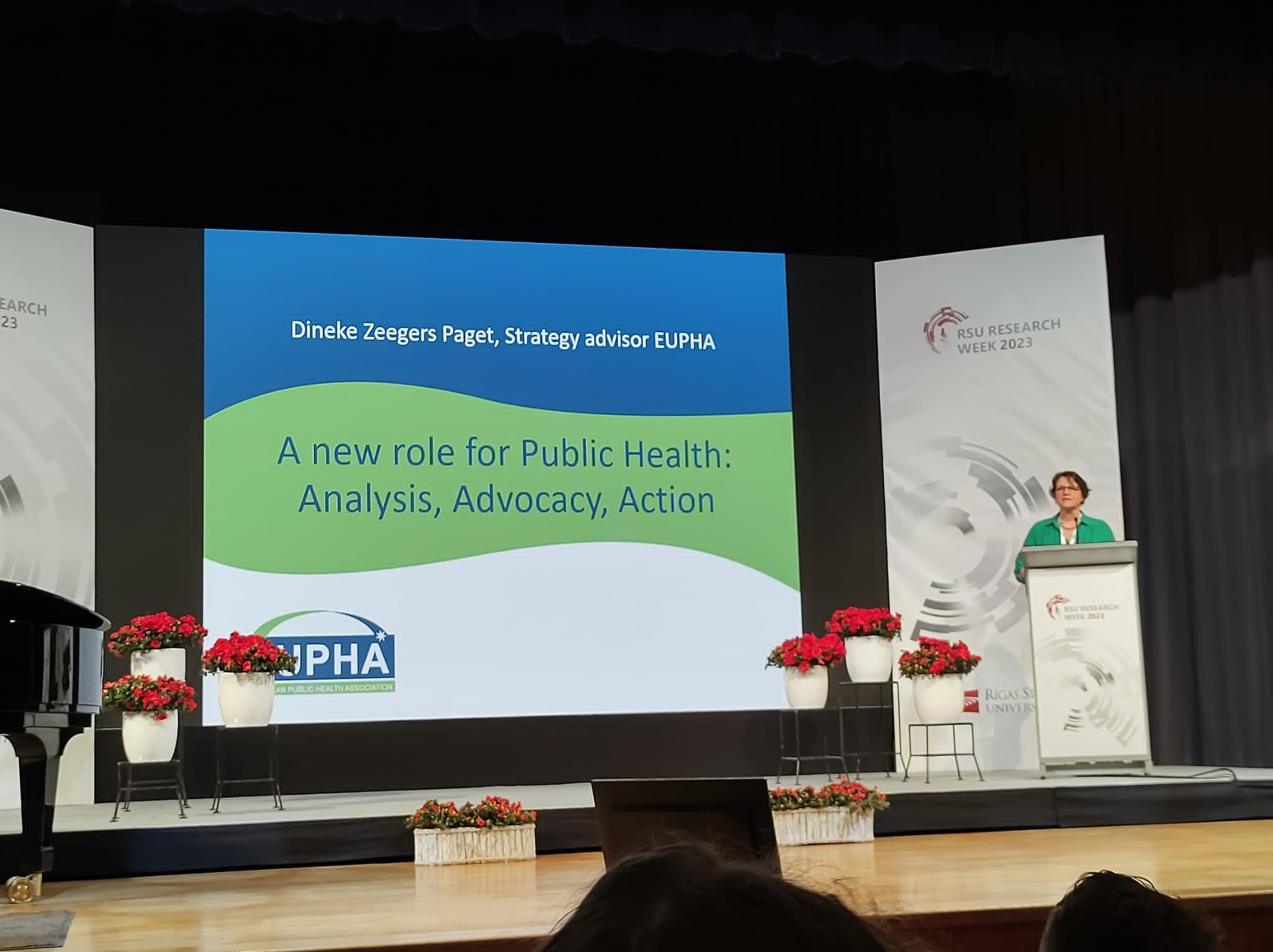
EUPHA’s strategic advisor, Dineke Zeegers Paget, was in Riga, Latvia visiting the Institute of Public Health to discuss opportunities to jointly improve public health in Europe. EUPHA is thankful for the invitation from the Institute and we look forward to future collaborations.
EUPHA endorses two joint statements from the 2022 Thematic networks of the EU Health Policy Platform
EUPHA participated in two of the 2022 thematic networks that were hosted on the EU Health Policy Platform and undersigns these:
|

3. European Public Health Week
We are only weeks away from the 2023 edition of our annual European Public Health Week! Make sure to leave some room in your calendars – between May 22nd and 26th – and get involved by:
Organising an event
Organising an event during the European Public Health Week (EUPHW) is an excellent way to promote your work and your passion. Webinars, social media campaigns, in-person lectures, yoga lessons or walks in the park… Almost anything is suitable, as long as it helps raise awareness about public health and promotes collaboration among the public health community in Europe. You can still submit your event
Watch this space! Over 50 events have already been announced for this year’s EUPHW and many more will be added to our events calendar in the coming weeks.
Help us disseminate the news about the EUPHW. Follow, like and share our website and social media posts on LinkedIn, Twitter and Facebook.
If you wish to receive all the relevant updates on the EUPHW, just send us a quick email to [email protected] and we will subscribe you to our special EUPHW-dedicated newsletter. For any other questions, feel free to use the same email or contact our EUPHW coordinator directly.
|

4. European Public Health Conference
16th EUROPEAN PUBLIC HEALTH CONFERENCE, DUBLIN, IRELAND,
|
5. EUPHA members update
The Spanish Society of Public Health and Health Administration (SESPAS) publishes technical report on “Climate Change and Health: an Ibero-American Vision”
The impact of climate change on human health is a significant concern, and action is needed to mitigate its effects. However, adaptation efforts are equally important to minimize the vulnerability of people to climate change-related health problems. This report, comprising of 16 chapters, provides a comprehensive overview of the key issues surrounding this critical public health concern.
|
6. European Journal of Public Health
Volume 33, Issue 2, April 2023
EDITORIAL
HEALTH SERVICES RESEARCH
SOCIAL DETERMINANTS
COVID-19
VACCINATION
MENTAL HEALTH
WORK AND HEALTH
NUTRITION
ALCOHOL
CANCER SCREENING
REPRODUCTIVE HEALTH
EUROPEAN PUBLIC HEALTH NEWS
|
7. Call for proposals, job opportunities
DARWIN EU® call for new data partners
DARWIN EU®, the Data Analysis and Real-World Interrogation Network, has accomplished its first year of establishment. Following the set-up of the DARWIN EU® Coordination Centre in February 2022, the first ten data partners were onboarded. The network also initiated its first four studies using real-world data (RWD) from across Europe to better understand diseases, populations and the uses and effects of medicines.
Scholar applications are now being accepted for the SPHeRE PhD Programme
The Structured Population and Health-services Research Education (SPHeRE) PhD Programme is for those applying for one of the six HRB funded SPHeRE Scholarships, or those who are self-funded.
|
8. Interesting news
A set of three interesting policy briefs on workforce by the European Observatory for Health Systems and Policies
Policy Brief 1: What did the COVID-19 pandemic teach us about future workforce development? Policies and practices to recruit, retain, reskill and support health and care workers.
NEW Finland: health system review
After two decades in the making, the major structural reform has centralized responsibility for the organisation of health and social services from municipal to regional level, and health system financing has moved to the national level. Read all about this in the newly published ‘Finland: health system summary’ by the European Observatory on Health Systems and Policies
|
9. Upcoming courses and conferences
|
10. Interesting publications
SDG5 “Gender Equality” and the COVID-19 pandemic: A rapid assessment of health system responses in selected upper-middle and high-income countries
Front Public Health | February 2023
The COVID-19 pandemic disrupted healthcare and societies, exacerbating existing inequalities for women and girls across every sphere. This study explores health system responses to gender equality goals during the COVID-19 pandemic and inclusion in future policies and found that pandemic policies strongly cut into women’s health, constrained prevention and support services, and weakened reproductive rights, while essential maternity care services were kept open. Read the full paper here.
The Challenges of Regulating Artificial Intelligence in Healthcare
Int J Health Policy Manag. | 2023
Regulation of health technologies must be rigorous, instilling trust among both healthcare providers and patients. This is especially important for the control and supervision of the growing use of artificial intelligence in healthcare. This commentary outlines key challenges that regulators face in dealing with these modern-day technologies.
Working together across WHO’s regions in an increasingly complex world
The Lancet | April 2023
WHO is unusual within the UN system in having a strong regional structure. Every 5 years all of WHO’s member states meet at the World Health Assembly in Geneva, Switzerland to elect a Director-General. Each member state is also a member of one of WHO’s six regions, which in turn elect Regional Directors. Read Prof. McKee’s full reflections here.
Global financing for health policy and systems research: a review of funding opportunities
Health Policy and Planning | April 2023
The Covid-19 pandemic has shown why investing in health policy and systems research is more important than ever to enable the delivery of effective health interventions and avoid costly implementation failures. The evidence presented in this article highlights the need to scale up efforts to convince global health funders to institutionalize the inclusion of HPSR components in all funding calls.
|
11. European Institutes news
Policy podcast: Mapping the cost of non-Europe: Towards a joint EU health policy
Joint EU action could be especially beneficial when negotiating contracts for medicines, investing in medical research, & responding to public health threats. Listen the podcast by the European Parliamentary Research Service here.
EU Health Policy Platform annual meeting
On 19 April the annual meeting of the EU Health Policy Platform took place. On the agenda were the presentation of the joint statements produced by the thematic networks i.e.:
Furthermore, the first results of the EU Health Policy Platform study and possible improvements to the Platform were discussed. It was a hybrid event with some participants participating in-person from Luxembourg. The flash report of the meeting is available here.
European Commissioner for Health and Food Safety Stella Kyriakides presenting to European Parliament the Pharmaceutical Package proposal
Following the adoption of the proposal by the College of Commissioners scheduled on 26 April, the Commissioner will present the package which will revise the EU regulatory framework for pharmaceuticals and also include proposals regarding medicines for rare diseases and children. The European Parliament has called for this long awaited revision in several occasions, including in its resolution on “A pharmaceutical strategy for Europe” of November 2021 outlining the Parliament’s recommendations for the revision.
|
12. European Centre for Disease Prevention and Control news
Eurosurveillance – Volume 28, Issue 14, 06 April 2023
Rapid communication
Eurosurveillance – Volume 28, Issue 15, 13 April 2023
Outbreaks
Eurosurveillance – Volume 28, Issue 16, 20 April 2023
Rapid communication
Eurosurveillance – Volume 28, Issue 13, 30 March 2023
Surveillance
|
13. WHO news
European Immunization Week 2023
From 23 till 29 April the WHO European Region celebrates European Immunization Week (EIW) to raise awareness of the importance of immunization in preventing diseases and protecting life. This year’s campaign will work to improve vaccine uptake in the context of the European Immunization Agenda 2030 and a global backslide in vaccination rates due to the COVID-19 pandemic.
“Being able to listen, having a true interest in what other people are saying” – mental health experts reflect on their work in refugee-receiving countries
“An emergency makes you forget everything you were taught about how health care is delivered,” says Rut Erdelyiova, a mental health and psychosocial support (MHPSS) consultant working in Slovakia. “It’s no longer that sterile environment where you know what you need to deliver. It’s about going out there to meet people who just experienced something that completely reshaped their realities, trying to understand how they’re feeling and what we can do for them in that situation.”
WHO/ECDC report: antimicrobial resistance threatens patient safety in European Region
The second “Surveillance of antimicrobial resistance in Europe” report, published jointly by the European Centre for Disease Prevention and Control (ECDC) and WHO/Europe on 14 April 2023, shows high percentages of resistance to last-line antibiotics, such as carbapenems, in several countries of the WHO European Region. More information about this report is available here.
Longer, healthier lives for all: WHO at 75
On 7 April, World Health Day, the World Health Organization celebrated 75 years of continuous work dedicated to improving human health. Over this time, WHO has made extraordinary advances in public health: average life expectancy across the WHO European Region’s 53 Member States in Europe and central Asia has increased by 16 years.
|
|
|
|
Unsubscribe
If you would like unsubscribe from the EUPHA newsletter then please click here.
|