 |
The European Public Health Association Newsletter – September 2022 |
1. Editorial
We are happy to again present you a well-filled EUPHA newsletter. In particular, we would like to draw your attention to the many recent advocacy activities EUPHA was involved in, and to the forthcoming series of interesting webinars that EUPHA is co-organising together with different partners. We hope you will join us in these events!
Iveta Nagyova, EUPHA president and Marieke Verschuuren, Executive Director
|
2. EUPHA update
EUPHA endorses the Oslo Declaration
EUPHA joins 80 international, European, and national civil society organizations and the World Health Organization in supporting the Oslo Declaration, which calls for urgent policy action to address alcohol-related harm. Evidence keeps showing the large contribution of alcohol consumption to the burden of non-communicable diseases (NCDs), while at the same time there are effective policy options that are not being implemented. We, representatives of public health professionals across the European region, fully support the ambitions of the Oslo Declaration.
EUPHA at the 72nd session of the WHO Regional Committee for Europe
EUPHA actively participated at the 72nd session of the WHO Regional Committee for Europe, which took place 12-14 September 2022 in Tel Aviv, Israel. Through the WHO Framework of Engagement with non State Actors accredited organisations, like EUPHA, can attend and participate in the Regional Committee meetings. EUPHA had the opportunity to deliver the two joint statements that were led by EUPHA. In total EUPHA was involved in four joint statements, i.e. on:
And EUPHA co-signed statements related to:
Furthermore, EUPHA submitted a video statement on agenda item 6 ‘Strengthening health emergency preparedness, response and resilience’, presented by our Executive Director Dr. Marieke Verschuuren. The video is available here.
Joint statement – Operating Grants for health NGOs
EUPHA and 14 other health organisations call on the European Commission to include Operating Grants as a financing mechanism to provide a strong foundation for the contribution of health NGOs as part of the 2023 Work Programme and beyond. Read our joint statement here.
EUPHA-ASPHER Joint statement: Join us in prioritising the investment in the next generation
The European Union has made 2022 the European Year of Youth, emphasising the importance of enabling the next generation to take a leading role in building a better future – greener, healthier and more inclusive. Both EUPHA and ASPHER have committed to investing in these young public health professionals, including them fully in our networks. We have made investing in the next generation a priority for both our organisations in 2022. Read about this in our joint statement, which is available here
The European Public Health Association (EUPHA) asked its members what they think are the most important priorities in public health in the coming 5 years. According to them, mental health is a top priority in European public health. In addition, lifestyle factors are key as they underly many chronic conditions that are deemed important priorities, such as cancer.
In September the PROPHET project kicked off at Università Cattolica del Sacro Cuore (UCSC) in Rome, Italy. UCSC is the coordinator of this project, which aims to engage organisations and individuals to contribute to the construction of a Strategic Research Innovation Agenda (SRIA) to adopt Personalised Prevention approaches into EU health systems. The coming four years EUPHA will lead various tasks within the project and contribute to the SRIA, stakeholder forum, capacity building for health professionals, and communication and dissemination activities.
Press release of the PROPHET kick off is available here.
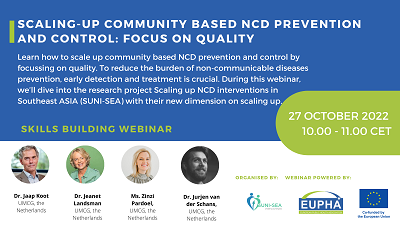
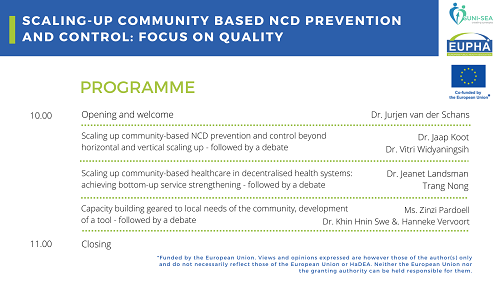
Join this skills building webinar organised by the SUNI-SEA consortium, powered by EUPHA. The SUNI-SEA consortium will share their experiences on scaling-up community based non-communicable diseases prevention. To reduce the burden of NCD prevention, early detection and treatment is crucial. During this webinar, we’ll dive into the research project Scaling up NCD interventions in Southeast ASIA (SUNI SEA) with their new dimension on scaling up.
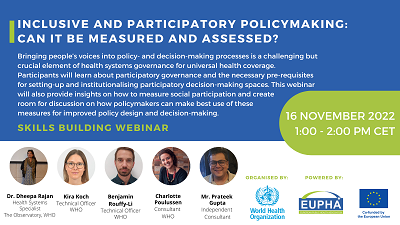
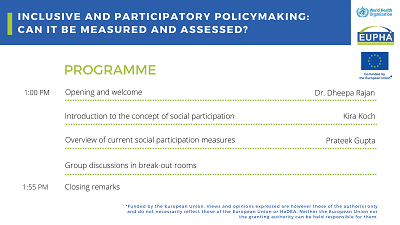
Bringing people’s voices into policy- and decision-making processes is a challenging but crucial element of health systems governance for universal health coverage. During this webinar, organised by WHO and powered by EUPHA, participants will learn about participatory governance and the necessary pre-requisites for setting-up and institutionalising participatory decision-making spaces. This webinar will also provide insights on how to measure social participation and create room for discussion on how policymakers can make best use of these measures for improved policy design and decision-making.
Learn about the environmental impact of the European Public Health Conference and what measures can be taken to minimize this impact. How can conferences such as the EPH Conference in Berlin be more environmentally responsible? Mark your calendar: November 2 from 2:00 – 3:30 PM (CET). The link for registration will soon be shared on social media channels.
|

3. European Public Health Conference
15TH EUROPEAN PUBLIC HEALTH CONFERENCE, 9 – 12 NOVEMBER 2022 – STRENGTHENING HEALTH SYSTEMS: IMPROVING POPULATION HEALTH AND BEING PREPARED FOR THE UNEXPECTED.
UPDATE PLENARY PROGRAMME
Plenary 5: Sustaining high quality care: interprofessional training for our clinical and public health workforce. Saturday 12 November, 10:30-11:30 CET. Organised by ASPHER and EHMA.
Moderators: John Middleton, Tara Chen, ASPHER. Keynotes by Natasha Azzopardi Muscat, WHO Regional Office for Europe, George Valiotis, EHMA. Panellists: Fatai Ogunlayi, UK Public Health Specialty Registrar, Laurent Chambaud, Andrija Stampar Medallist 2022, Anett Ruszanov, Director of Policy and Programmes, EHMA.
Read more about the conference theme and plenary programme here.
LUNCH SYMPOSIUMS
We are organising an exciting lunch symposiums programme during the extended lunch hours. No separate registration required. Just take your lunch to the breakout room and take part.
Thursday 10 November
Friday 11 November
Read more on our website.
UPDATE PRE-CONFERENCES
Pre-conferences are held on Wednesday 9 November. The full programme can be found on our website. Updates:
REGISTRATION
More than 2,000 colleagues have already registered. Meet your colleagues at the largest public health event in Europe during four fully packed conference days. More information is available here.
PANDEMIC PREPAREDNESS
There are currently no restrictive measures for the event industry in place in Berlin. Event organizers are free to decide whether and how to make use of protective measures. For the EPH Conference 2022 we will follow the recommendations for responsible events to ensure our delegates can attend the conference safely. Current measures in Berlin can be followed in detail on the websites of VisitBerlin and the State of Berlin.
CONFERENCE VENUE
The 15th EPH Conference will be held in the hub27 Berlin, part of Messe Berlin. Hub27 is easily accessed by U-Bahn and S-Bahn from all parts of Berlin. You can reach Berlin by train from everywhere in Europe. Long-distance high-speed trains arrive at and depart from the Hauptbahnhof. Flights to and from the new Berlin-Brandenburg International Airport (BER), 20 km from the city centre.
|
4. EUPHA members update
In memoriam Carla Nunes
|
5. European Journal of Public Health
Advance articles – September 2022
Changes in healthy and unhealthy working life expectancies among older working-age people in Finland, 2000–2017
|
6. Call for proposals, job opportunities
BMC’s call for papers – Climate impacts on health
BMC Public Health has launched a collection adressing climate impacts on health. Authors are invited to submit manuscripts until 7 April 2023.
|
7. Interesting news
Food as medicine: could prescribing fruit and vegetables become part of healthcare?
The Guardian | 18 September 2022
Scientists reveal how air pollution can cause lung cancer in people who have never smoked
The Francis Crick Institute | 10 September 2022
|
8. Upcoming courses and conferences
|
9. Interesting publications
Sleep and sleep disorders
The Lancet Commissions | 14 September 2022
The Ethical Spirit of EU Values: Status Quo of the Union of Values and Future Direction of Travel
Springer | Open Access Book | 2022
It covers the individual values of the EU, as well as their relationship to each other (e.g. general values and health values), but also to other provisions of EU law (e.g. value of human dignity in current EU documents on digitization).
The book not only presents the status quo (e.g. energy solidarity), but also includes suggestions for future developments (e.g. environmental protection as a value, etc.). The Lancet Commission on lessons for the future from the COVID-19 pandemic
The Lancet Commissions | 14 September 2022
Health Equity: Law and Policy
Health and Medicine | Collection | September 2022
EUPHA members’ priorities – selection on mental health
EUPHA’s member survey indicated that one of the public health priorities for our members is mental health. Therefore, we have compiled some recent and interesting articles relating to this research field, in addition to the usual interesting publication that we share in the newsletter.
Challenges for addressing dementia
In this editorial, authors explain that economic, social, scientific, and clinical challenges represent substantial setbacks for the treatment and management of dementia at an individual and societal level. To prepare for the expected increase in dementia burden in the future, fast-paced research advancements will be needed to improve drug therapy, enhance economic support from governments, and increase in awareness and sensitivity about the disease.
The mental and physical health of young carers: a systematic review
The health of those who care for someone with a health condition or advanced age is poorer, on average, than non-carers. However, the health of young carers (<18 years of age) has been under-researched, especially in quantitative studies. This systematic review aimed to summarise studies assessing the mental and physical health of young carers.
|
10. European Commission news
European Health Union: A new EU approach on cancer detection – screening more and screening better
On September 20th, as part of the EU Cancer Screening Scheme to be put forward under Europe’s Beating Cancer Plan, the Commission presented a new approach to support Member States increasing the uptake of cancer screening. Focusing on detection of cancers at an early stage, the objective of the proposed recommendation is to increase the number of screenings, covering more target groups and more cancers.
Statement by European Commissioner for Health and Food Safety Stella Kyriakides and WHO Regional Director for Europe Dr Hans Henri P. Kluge on preventing monkeypox from becoming endemic in Europe
On September 13th, on the occasion of the 72nd session of the WHO Regional Committee for Europe, the Commissioner for Health and Food Safety, Stella Kyriakides, and WHO Regional Director for Europe, Dr Hans Henri P. Kluge, reconfirmed their joint efforts to prevent monkeypox from becoming endemic in Europe.
Environmental implementation: Commission urges better application of EU environmental rules to protect human health and the environment
On September 8th, the Commission published the third Environmental Implementation Review (EIR), a key reporting tool that supports environmental enforcement and raises awareness about the importance of implementing environmental rules.
European Commission’s Study on AMR – Invitation to participate in consultation of stakeholders
The “Study on the barriers to effective development and implementation of national policies on antimicrobial resistance (AMR)” is commissioned by HaDEA in close cooperation with DG SANTE and conducted by Tetra Tech International Development and partners. In relation to this study you are invited to contribute in two ways:
Your contribution to the study will be much appreciated.
|
11. European Centre for Disease Prevention and Control news
Eurosurveillance – Volume 27, Issue 38, 22 September 2022
Rapid communication
Improving risk communication in public health crises
The ECDC team interviewed Dr Savoia, speaker at ECDC’s risk communication workshop.
Eurosurveillance – Volume 27, Issue 35, 01 September 2022
Editorial
Eurosurveillance – Volume 27, Issue 36, 08 September 2022
Rapid communication
Eurosurveillance – Volume 27, Issue 37, 15 September 2022
Rapid communication
|
12. WHO news
Ticking timebomb: Without immediate action, health and care workforce gaps in the European Region could spell disaster
All countries of the WHO European Region – encompassing 53 Member States across Europe and central Asia – currently face severe challenges related to the health and care workforce, according to a new report released by WHO/Europe. Yet, some steps can and should be urgently taken in order to strengthen the health and care workforce.
Simplicity, transparency and trust – essential in health data reporting
A new study by HealthPros (a training network for health-care professionals) and WHO/Europe shows that countries faced challenges in the way COVID-19 information was presented and disseminated. While visual and dynamic displays of key data – COVID-19 dashboards – were swiftly developed in the first months of the pandemic, countries faced issues related to the need for simplicity, the use of open data, transparency and trust.
Involving youth in alcohol policies: imagining and planning for a better world
“If we want effective policies, we need to include young people in shaping, implementing, and monitoring them, because young people are the fastest evolving community in the world. I am a young person and when I scroll through social media, I need to see content that is trendy now, that is changing fast, while the process of policy change is slow.”
Behavioural insights and digital health action plans endorsed by Member States on the second day of the Regional Committee
Behavioural and cultural insights are a flagship initiative of the European Programme of Work, and on day two of the 72nd Regional Committee, Member States adopted an action framework to drive work in this area until 2027. The flagship’s framework calls on Member States to make use of behavioural and cultural insights (BCI) for effective, tailored, equitable, sustainable and people-centred health policies.
Technical Advisory Group on the mental health impacts of COVID-19 in the WHO European Region briefing
This briefing addresses the mental health impacts of COVID-19 across the European Region and associated opportunities for action.
Core health indicators in the WHO European Region
This publication presents the core health indicators in the WHO European Region with a special focus on the European Programme of Work Measurement Framework.
Urban design for health: inspiration for the use of urban design to promote physical activity and healthy diets in the WHO European Region
A symposium held by WHO Regional Office for Europe in collaboration with Gehl in April 2021 explored how to advance concrete actions in support of healthier environments and behaviour in cities through urban planning and design, with a focus on physical activity and health diets.
Invisible numbers: the true extent of noncommunicable diseases and what to do about them
This report is a reminder of the true scale of the threat posed by non-communicable diseases (NCDs) and their risk factors. But, crucially, it also shows what can be done to avoid them. There are cost-effective and globally applicable interventions that can protect people from NCDs or minimize their impact. Every country, no matter its income level, can and should be using and benefitting from these policies – saving lives and saving money.
Imagining the future of pandemics and epidemics: a 2022 perspective
The World Health Organization’s 1st foresight report – “Imagining the Future of Pandemics and Epidemics”, attempts to explore what the future of infectious threats might look like, using a short time horizon (3-5 years) to encourage immediate action.
|
|
Funded by the European Union. Views and opinions expressed are however those of the author(s) only and do not necessarily reflect those of the European Union or HaDEA. Neither the European Union nor the granting authority can be held responsible for them.
|
|
Unsubscribe
If you would like unsubscribe from the EUPHA newsletter then please click here.
|