 |
The European Public Health Association Newsletter – May 2025 |
1. Editorial
Each year, the European Public Health Week (EUPHW) grows in strength, reach and impact—and 2025 was no exception. With 298 events held across 21 countries and in 14 languages, this year’s EUPHW brought communities, professionals and institutions together to shine a light on public health. From grassroots initiatives to academic roundtables, the week showcased the extraordinary diversity and energy of Europe’s public health ecosystem.
We launched EUPHW 2025 in the European Parliament with a powerful and urgent message: health is a strategic asset. The event brought together high-level voices from across Europe, including Dr. Raed Arafat, Secretary of State of Romania and Chair of NATO’s Joint Health Group, who reminded us that “in crisis, we will be judged not only by how we fight, but by how we care.” Discussions focused on how resilient health systems are essential to Europe’s security, how innovation – from Ukraine’s mobile clinics to AI surveillance – must be inclusive and community-led, and why EU4Health and Horizon Europe are long-term investments in our collective defense. We’re grateful to our distinguished speakers, citizen representatives from Romania and Ukraine, and to MEPs Nicu Ștefănuță and Victor Negrescu for hosting us and keeping health high on Europe’s agenda.
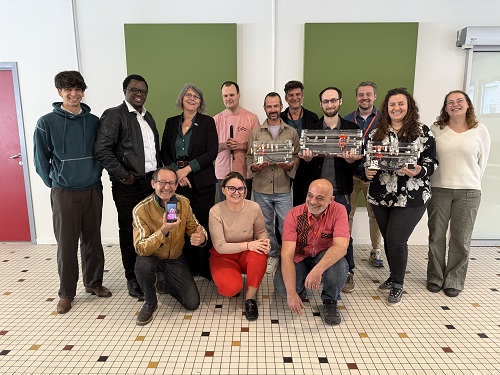
Another standout moment of the week was our in-person hackathon in Brussels, where brilliant minds came together to make 3D-printed Braille more accessible, affordable and open-source. In just two days, three Braille embossers were built and validated on-site. Each machine was tested and approved by a volunteer from Ligue Braille with a visual impairment – proof of the project’s immediate impact. The finished embossers were donated to Ligue Braille, showing how innovation and solidarity can go hand in hand to reduce health and access inequalities.
Whether in person (183 events), online (103) or hybrid (12), each of the 298 events held during EUPHW 2025 helped reinforce a core truth: public health is not a side conversation – it is central to Europe’s future. The energy, innovation and solidarity we saw throughout the week are the foundation of a growing movement. EUPHW is not just a moment; it’s a movement – a collective force for change. Let’s keep building on it, together.
Dr. Tit Albreht, EUPHA President
|
2. EUPHA news
Last chance to register: 6th International Summer School in Public Mental Health 2–6 June 2025 | Gdańsk, Poland
EUPHA’s Public Mental Health Section, together with the Medical University of Gdańsk and ASPHER, invites you to join the 6th International Summer School in Public Mental Health. This year’s programme focuses on Trauma-informed Public Health: Approaches to Resilience and Trauma-Informed Care—a timely and essential topic for professionals working to improve mental health outcomes.
Designed for social support workers, local public health professionals, psychologists and therapists, the summer school offers a rich mix of sessions on trauma-informed approaches, the impact of trauma, and how public health strategies can foster resilience at both individual and community levels.
The summer school runs alongside the EUPHA Public Mental Health Conference and includes a full agenda of lectures, workshops and networking opportunities.
Register by Sunday, 1 June 2025, to secure your place. For full details visit the summer school page. You can also explore the conference agenda to see what’s planned throughout the week.
Upcoming EUPHA Section webinar
Before we pause our Section webinar series for the summer, join us for our last sessions in June. Our Sections have been active throughout the year, bringing together experts across Europe and beyond to discuss pressing public health challenges. Do not miss this opportunity to stay informed and connect with the latest research and policy developments.
26 June, 16:00–17:00 CEST
Domitilla Marconi from the University of Siena, Italy, will present the national strategy behind the Italian Fund for Alzheimer’s and Dementia and its role in strengthening Italy’s public health response to dementia. Register for the webinar.
Have you missed a previous webinar? Browse past EUPHA Section webinars (login required).
Health literacy: A cornerstone of Europe’s Democracy Shield
EUPHA, together with our Health Literacy Section, has submitted a contribution to the European Commission’s consultation on the European Democracy Shield. Our central message is clear: empowering people to access, understand, and act on health information is essential not only for public well-being — but for the health of our democracies.
To reflect this message, we highlighted the historic KU Leuven Library — burned in both World Wars and rebuilt each time through global solidarity. It stands as a powerful symbol: knowledge can be threatened, but it must never be surrendered. Today, as Europe faces rising waves of disinformation and hybrid threats, we must once again defend evidence — and with it, democracy.
Key messages from our position paper:
Read EUPHA’s full contribution to the European Democracy Shield.
Declaration on Health Inequalities, Prevention and Risk Factors launched at European Parliament
On 22 May, the MEP Interest Group on Health Inequalities, Prevention and Risk Factors officially launched its new Declaration at a reception in the European Parliament.
During the reception, co-chairs Vytenis Andriukaitis, Manuela Ripa, and Ondrej Dostal shared personal perspectives on what must be done to strengthen health promotion across Europe. They underscored the importance of prevention as a life-saving, cost-effective approach that complements — rather than compromises — personal freedom. Civil society’s vital role in connecting people and policy was also a recurring theme.
Dr. Gauden Galea, Strategic Advisor on NCDs and Innovation at the World Health Organization, delivered a compelling video message. He pointed out that ten countries in the WHO European Region are currently on course to meet their non-communicable disease (NCD) targets — encouraging news ahead of this September’s High-Level Meeting on NCDs in New York. His message was clear: Europe must act decisively and lead by example.
As NCDs continue to account for 80% of deaths in the EU, and absorb up to 10% of GDP in healthcare costs, the need to prioritize prevention, tackle health inequalities, and address risk factors is more urgent than ever. The Declaration calls for these areas to receive greater political attention and adequate investment at both EU and national levels.
The Interest Group is supported by a joint secretariat from Eurocare, EuroHealthNet, and EUPHA.
|
3. European Public Health Week
Thank you for making EUPHW 2025 a success
To everyone who helped bring European Public Health Week 2025 to life – thank you.
From the local organizers and event hosts to our incredible speakers, partners and attendees, your energy, ideas and dedication made this year’s EUPHW our most impactful yet. Whether you led a session, shared your story, asked a question, or simply showed up – you were part of something bigger.
Together, we held 298 events in 14 languages, online and in person, showing what’s possible when we unite around a common goal: better public health for all.
EUPHW webinar recordings now available
Each morning during European Public Health Week 2025, we kicked off the day with a live webinar exploring the daily theme. These sessions brought together expert speakers, inspiring stories, and practical examples from across Europe—setting the tone for the day and sparking important conversations.
From strengthening health systems to addressing the commercial determinants of health, each webinar offered a fresh perspective on today’s most pressing public health challenges. If you missed them or want to revisit the highlights, all four recordings are now available to watch at your convenience.
Watch the recordings:
Whether you’re looking for insights, ideas or inspiration, these webinars are a great place to start. Thank you to all our speakers and attendees for making each morning count!
|
4. European Public Health Conference
Pre-conference programme now available
We’re pleased to announce a dynamic line-up of pre-conferences taking place on Tuesday 11 November in Helsinki. Themes span a wide range of pressing public health issues, including:
The programme also includes the THCS Annual Conference 2025, hosted as part of this year’s pre-conference events. Click here for the full programme and details.
Registration is required. You can book a pre-conference when registering for the main conference, or add one to an existing registration by emailing your request to: [email protected].
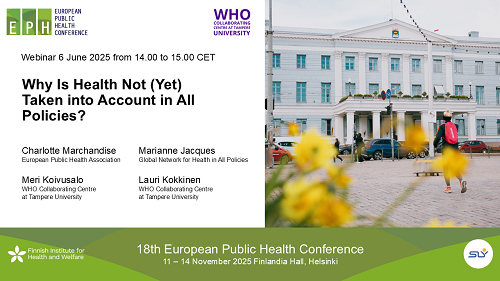
Webinar series: Why is health not (yet) taken into account in all policies?
As part of the lead-up to the 2025 European Public Health Conference (EPH2025), the next session in our webinar series will explore one of the central challenges in public health today: integrating health considerations across all areas of policymaking.
Date: Friday, 6 June
This session will focus on the practical and political barriers to implementing Health in All Policies (HiAP) approaches, including conflicting priorities within government and the influence of commercial interests. It will also explore the role of the public health community in building cross-sectoral alliances to keep health on political agendas — from local to international levels.
Missed our latest webinar on participatory research? The recording is now available
If you weren’t able to join us on 16 May for the second webinar in our series, Participatory research in action: Towards inclusive and ethical health policy & practice, you can now catch up by watching the full recording online.
This engaging session explored how participatory research is helping to build more inclusive and ethical health systems, with a particular focus on ethnic minorities and Indigenous peoples. Speakers shared practical examples from Finland, Portugal, and the United States on how to meaningfully involve communities in shaping policy and practice.
Watch the participatory research webinar recording.
|
5. European Institutions’ news
Council of the European Union
26 May – Council adopts conclusions on EU health aid, backing the Court of Auditors’ call for more value, more accountability, and less waste in global health investments.
23 May – Council reaches deal on the Soil Monitoring Law, introducing EU-wide criteria for soil health and contamination, and linking soil policy to food security, climate goals, and disaster resilience.
23 May – Council adopts conclusions on the use of satellite and AI-driven earth observation data for crisis response. The text calls for real-time data use in disasters, common EU standards, and robust cybersecurity to turn satellite systems into a core tool for resilience, civil protection, and public safety.
23 May – Council adopts conclusions on an EU Strategy for AI in Science, calling for fair access to data and computing power, ethical AI standards, and upskilling researchers to harness AI responsibly. The initiative aims to boost Europe’s leadership in scientific innovation while protecting research integrity.
13 May – Council and Parliament reach agreement to harmonize population and housing statistics across the EU. The new rules introduce a common definition of ‘population’ and aim to improve data quality and comparability, supporting EU policy-making and administrative functions.
8 May – President Costa calls for a genuine European defence, renewed multilateralism, and strategic partnerships with emerging powers like Kenya, positioning the EU as an active architect of global peace in a fragmented world and calling competitiveness and defence two sides of the same coin.
6 May – President Costa calls for a stronger, more competitive Europe anchored in strategic defense, open trade, and regional innovation, urging Catalonia and other regions to drive EU prosperity while warning that peace without defense is an illusion.
European Commission
23 May – The EU launches the “Choose Europe for Science” package to attract top research talent, unveiling €500 million in new funding, expanded ERA Chairs, and consolidated support schemes across all Member States to make Europe the world’s most attractive research destination.
22 May – Commission publishes 2025 report on EU blue economy – European Commission
22 May – The EU launches the European Vaccine Hub in Siena, aiming to cut vaccine development time to under four months and strengthen pandemic preparedness through a €102 million HERA-funded consortium of leading public and private actors.
21 May – DG SANTE hosted a key meeting to advance One Health Agenda with ECDC, EMA, EFSA, EEA and ECHA.
19 May – The EU strengthens border security with the launch of a shared biometric matching system and new rules allowing the screening and registration of irregular migrants before asylum procedures, enhancing identity checks and accelerating returns.
8 May – ECDC charts future path for public health resilience through strategic foresight
European Parliament
13 May – Parliament President Pushes for Pro-Industry EU
7 May – MEPs Call for Stronger EU Water Resilience
7 May – MEP increase scrutiny on EU Budget and NGO transparency
7 May – MEPs Advocate People-Centered De-risking
|
6. Call for proposals, job opportunities
PhD Opportunity: Public Health Economics
Erasmus University Rotterdam is recruiting a PhD candidate to study how crises like climate change and COVID-19 impact health, inequality, and workforce participation. Using large-scale data and simulation models, the research will inform policies to reduce disease burden and improve population health. Closing date 30 June 2025.
More information here.
|
7. Upcoming courses and conferences
|
8. Interesting publications
World report on social determinants of health equity
This comprehensive World report on social determinants of health equity, as requested by resolution WHA74.16, reviews the insufficient progress on meeting the Commission on Social Determinants of Health’s targets on achieving health equity and focuses the narrative and action agenda on what produces and reproduces health inequities and what proven policy remedies are available. The report includes 14 specific recommendations for action within four action areas. Country examples throughout the report showcase actions and diverse strategies for actioning the report’s recommendations across different contexts. The report aims to inform global, national and local policymaking, providing a foundation for coordinated action and investment in social determinants of health equity.
Integrating multimorbidity education into undergraduate medical curriculum: A systematic review
Multimorbidity is becoming highly prevalent across the globe. Current medical curricula predominantly focus on single-disease management, leaving future physicians underprepared to provide patient-centred care to address the multimorbidity epidemic. Through a systematic review, this short communication identified the current state of multimorbidity education in medical curricula and evaluated existing educational approaches. A narrative systematic review of studies meeting stringent inclusion criteria focusing on multimorbidity education was conducted. The review found limited evidence regarding the integration and effectiveness of current educational approaches.
Transforming women’s health, empowerment, and gender equality with digital health: evidence-based policy and practice
The authors evaluated the effects of digital health technologies (DHTs) on women’s health, empowerment, and gender equality, using the scoping review method. Following a search across five databases and grey literature, they analysed 80 studies published up to August 2023. The thematic appraisal and quantitative analysis found that DHTs positively affect women’s access to health-care services, self-care, and tailored self-monitoring enabling the acquisition of health-related interventions. Use of these technologies is beneficial across various medical fields, including gynaecology, endocrinology, and psychiatry. DHTs also improve women’s empowerment and gender equality by facilitating skills acquisition, health education, and social interaction, while allowing cost-effective health services. Overall, DHTs contribute to better health outcomes for women and support the UN Sustainable Development Goals by improving access to health care and financial literacy.
Leveraging innovative research tools to meet public health challenges: a BioMed21 workshop report
In November 2024, Humane Society International/Europe (now Humane World for Animals) hosted a policy workshop on behalf of the BioMed21 Collaboration to explore how human-centric, non-animal methods can address unmet medical needs and public health challenges. The event brought together experts across sectors to discuss innovative tools, systems-based approaches, and ways to make biomedical research more impactful, future-proof, and aligned with societal needs.
A full report shares key insights and recommendations.
|
|
|
|
Unsubscribe
If you would like unsubscribe from the EUPHA newsletter then please click here.
|


.jpg)