 |
The European Public Health Association Newsletter – June 2019 |
1. Editorial
Welcome to our June newsletter. In this newsletter we welcome new EUPHA members. Furthermore, you will find several interesting summer courses and schools that will take place the coming months, opportunities to provide input on EU projects, and updates from the European Commission, European Centre for Disease Prevention and Control, WHO Regional Office for Europe
Wishing you nice summer and pleasant reading,
Natasha Azzopardi Muscat, EUPHA president, and Dineke Zeegers Paget, EUPHA executive director
|
2. EUPHA update
EUPHA president at the European Health Management Association annual conference
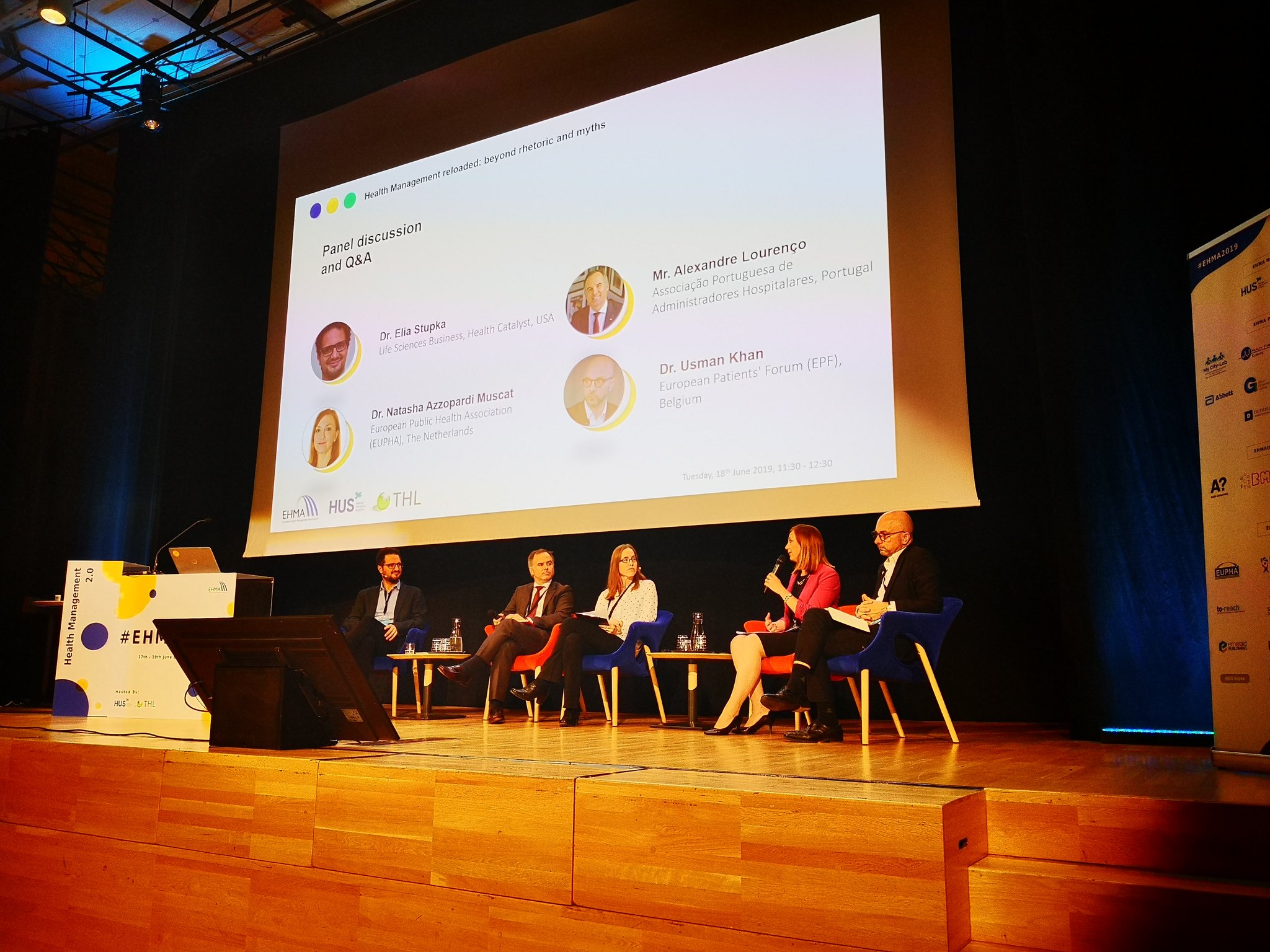
Natasha Azzopardi-Muscat, EUPHA president, participated in a plenary session at the annual meeting of the European Health Management Association held in Espoo, Finland (17-19 June 2019).
Natasha Azzopardi-Muscat took part in the panel discussion ‘Data Impacts Lives: Towards a Zero Patients Vision by 2030’. Her key points were:
New challenges for public health in the 21st century
In the July issue of Open Access Government, Dineke Zeegers Paget, Executive director of EUPHA, presents her top 5 challenges for public health in the 21st century.
Food and Public Health: a collection of papers
The Food and Public Health collection presents a selection of papers from Oxford journals, including six articles from the European Journal of Public Health. This collection aims to drive a conversation about food and nutrition in relation to health. The paper topics cover aspects of food and health ranging from childhood, food choice, diet, and more.
The collection is available free of charge until November 2019.
Welcome to GGD GHOR Nederland
We are happy to present the GGD GHOR Netherlands as a new member in the EUPHA network. GGD GHOR Nederland is the Association of GGD’s (Regional Public Health Services) and GHOR-(Regional Medical Emergency Preparedness and Planning) offices in the Netherlands. We represent the interests of the 25 GGD’s and GHOR offices on national level to stimulate improvements in Public Health and safety and the quality of the Public Health services. GGD’s and GHOR-offices contribute to safeguarding, improving and protecting the health of the Dutch people.
Welcome to the Institute of Public Health in Ireland (IPH)
We welcome the Institute of public health in Ireland as a new institutional member in our EUPHA network. The Institute of Public Health in Ireland (IPH) provides evidence, advice and leadership to promote health and wellbeing, and reduce health inequalities on the island of Ireland, North and South.
EUPHA meets the Director-General of DG Sante
On Thursday 27 June, Natasha Azzopardi Muscat and Dineke Zeegers Paget had the opportunity to meet with Ms Anne Bucher, the director-general of DG Sante. Discussions included current and future public health challenges in Europe and neighbouring countries.
President of EUPHA CAPH presenting at the 9th EUROPAEDIATRICS Congress in Dublin, Ireland, June 13-15, 2019
Danielle Jansen, president of the EUPHA Child and adolescent public health (CAPH) section, presented EUPHA at the 9th Europaediatrics Congress in Dublin this month. Her presentation was on “The role of EUPHA in coordinating research on child health care services in Europe”.
Help define health data collection methods and procedures
Which methods of data collection for population health monitoring and public health surveillance and health system performance assessment do you know? Share your knowledge with InfAct.
IV International Summer Course on Public Mental Health: “research in public mental health and resilience”
The summer course on public mental health is taking place 7-11 October 2019 in Vilnius, Lithuania and EUPHA is co-organiser.
The objective of this course is to develop research competences in public mental health and resilience that will enable elaborating a research idea and preparing a research paper.
Learning outcomes:
Registration: https://pmhconference.eu/school/registration
Don’t miss a unique chance to present the outcomes of your research in the field of non-communicable diseases
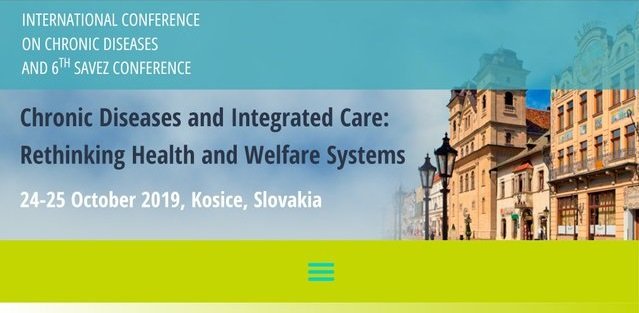
The international conference on chronic diseases and 6th SAVEZ conference will take place 24-25 October 2019, Kosice, Slovakia. This year’s theme is Chronic Diseases and Integrated Care: Rethinking Health and Welfare Systems. Abstracts can be submitted until 30 June 2019. The main conference organiser is EUPHA Chorinic diseases section.
|

3. European Public Health Conference
Programme
The programme for the 12th EPH Conference in Marseille, France is available. Please, check our webpage!
Financial support
We are very pleased to offer financial support to a limited number of participants of the European Public Health Conference 2019 in Marseille, France.
Financial support will include registration fee to the main conference and Welcome reception. Any additional fees for pre-conference registration, Conference Dinner etc. and costs of travel and accommodation are not included and should be paid directly by participants.
If you would like to apply please, contact our Conference officer, Robert Klarecki, at [email protected], and mention your:
Please use the following in the email subject line: Funding by EPH Conference Foundation [or] Funding by EUPHA, depending on your selection.
Deadline: 15 July 2019
Register and confirm by 1 August that you will be presenting your abstract!
|
4. EUPHA members update
Welcome to PH Ned
We welcome PH Ned (Public Health Netherlands) as a new member in the EUPHA network. PHned is a national network of professionals working in the field of public health in the Netherlands. Main goals as defined in the vision document are: Sharing knowledge, Networking and Lobbying. Welcome to Department of Public Health of the Babeş-Bolyai University
We welcome the Department of Public Health of the Babeş-Bolyai University in Cluj-Napoca, Romania, as a new institutional member in the EUPHA network. The Department of Public Health of the Babeş-Bolyai University is committed to conduct excellent research and teaching in public health. The department is running a full-range of educational programs in public health (bachelor, masters, PhD, executive) aiming to provide its students the necessary knowledge and skills to tackles the complexities of public health in Romania and worldwide. |
5. European Journal of Public Health
The European Journal of Public Health is a multidisciplinary journal in the field of public health.The European Journal of Public Health is published bimonthly. The journal provides a forum for discussion and debate of current international public health issues with a focus on the European region. In 2018, the impact factor of the journal is at 2.234. The 5-year impact factor is 3.069. The European Journal of Public Health is the official journal of EUPHA.
Advanced access June 2019
Healthcare use in patients with multimorbidity
|
6. Call for proposals, job opportunities
Aarhus University is looking for professors
Professor(s) in the field of General Practice, Biostatistics, Nursing, Public Health or Sport Biological Research
The Department of Public Health, Faculty of Health at Aarhus University, Denmark invites applications for one or more positions as professor in the fields of General Practice, Biostatistics, Nursing, Public Health and Sport Biological Research. Employment will be from January 1, 2020 or as soon as possible after this date. The position(s) are permanent and full-time, but part-time employment is negotiable.
As professor at Department of Public Health, you will be part of an ambitious and internationally recognised department, where we work together to promote public health through research into areas that can prevent, treat and alleviate disease. We are involved in broad collaboration both internally and externally. We share our knowledge with citizens, decision-makers, business and industry, practitioners and other researchers – in municipalities, in the regions and both nationally and internationally.
Please consult the faculty’s Guidelines for applicants.
|
7. Interesting news
What biodiversity loss means for our health
https://blog.oup.com/2019/06/what-biodiv…
Brexit Britain’s vaping paradise
Some U.K. lawmakers think they’ve found a way to reduce British smoking deaths: Brexit. Large numbers of British cigarette smokers will switch to vaping once the U.K. leaves the block, they argue, if looser British tobacco laws replace tighter EU limits on nicotine advertising and packaging.
Health: The priorities of the European Commission
The priorities of Vytenis Andriukaitis, the current European Commissioner for Health & Food Safety are explained here: including big data, tackling antimicrobial resistance and support science and innovation.
Cardiovascular disease: Opportunities and challenges in the digital health era
In this interview, Chair of the ESC Digital Health Committee, Professor Martin Cowie, details the opportunities and challenges in the digital health era when it comes to the field of cardiovascular disease
HIV, children, and obesity: too soon for conclusions?
https://www.thelancet.com/journals/lanch…
San Francisco becomes first US city to ban sale of e-cigarettes
https://www.theguardian.com/us-news/2019…
Climate action urgently required to protect human health in Europe
New EASAC report “The imperative of climate action to protect human health in Europe” highlights an alarming range of health risks due to climate change, and the benefits of rapid phase out of fossil fuels In this landmark report, the European Academies’ Science Advisory Council (EASAC) focuses on the consequences of climate change for human health in Europe and the benefits of acting now to reduce greenhouse gas emissions in order to stabilise the climate. EASAC is the voice of independent science advice, mobilising Europe’s leading scientists from 27 national science academies to guide EU policy for the benefit of society. By considering a large body of independent studies on the effects of climate change on health, and on strategies to address the risks to health, EASAC has identified key messages and drawn important new conclusions. The evidence shows that climate change is adversely affecting human health, and that health risks are projected to increase. Solutions are within reach and much can be done by acting on present knowledge, but this requires political will.
Use some antibiotics more and others less to stem resistance, says WHO
https://www.bmj.com/content/365/bmj.l428…
|
8. Upcoming courses and conferences
|
9. Interesting publications
Monitoring Frameworks for Universal Health Coverage: What About High-Income Countries?
http://www.ijhpm.com/article_3612.html
The Need for a Dynamic Approach to Health System-Centered Innovations; Comment on “What Health System Challenges Should Responsible Innovation in Health Address? Insights From an International Scoping
http://www.ijhpm.com/article_3622.html
INSPIRE Handbook: action for implementing the seven strategies for ending violence against children
https://www.who.int/violence_injury_prev…
What quantitative and qualitative methods have been developed to measure the implementation of a life-course approach in public health policies at the national level?
http://www.euro.who.int/en/publications/…
Falling through the cracks: Exposing inequalities in Europe and beyond
https://gcap.global/news/new-sdg10-repor…
SDG Accountability Handbook: A Practical Guide for Civil Society
https://sdgaccountability.org/about-the-…
Patient experience with outpatient care in Hungary: results of an online population survey
https://link.springer.com/article/10.1007/s10198-019-01064-z
Unmet medical needs in ambulatory care in Hungary: forgone visits and medications from a representative population survey
https://link.springer.com/article/10.1007%2Fs10198-019-01063-0
Physical activity trajectories and mortality: population based cohort study
https://www.bmj.com/content/365/bmj.l232…
Alcohol complicates multimorbidity in older adults
https://www.bmj.com/content/365/bmj.l430…
Lancet series: Gender Equality, Norms, and Health
https://www.thelancet.com/series/gender-…
Prevalence of maternal mental illness among children and adolescents in the UK between 2005 and 2017: a national retrospective cohort analysis
https://www.thelancet.com/journals/lanpu…
An online healthy relationship tool and safety decision aid for women experiencing intimate partner violence (I-DECIDE): a randomised controlled trial
https://www.thelancet.com/journals/lanpu…
The shifting epidemiology of colorectal cancer
https://www.thelancet.com/journals/langa…
Use of the WHO Access, Watch, and Reserve classification to define patterns of hospital antibiotic use (AWaRe): an analysis of paediatric survey data from 56 countries
https://www.thelancet.com/journals/langl…
|
10. European Commission news
Pharmaceuticals: Germany becomes the 27th Member State to benefit from the EU-US mutual recognition agreement for inspections
https://ec.europa.eu/newsroom/sante/news…
European Semester: Commission proposes health recommendations
The Commission has adopted proposals for country specific recommendations, including on health and investments in health as part of its ongoing assistance to Member States in implementing their health systems reforms in the light of an ageing population. The Commission recommends that the governments of 16 Member States invest in their national health systems or improve their effectiveness, increase accessibility and strengthen their resilience, with the following recommendations.
The Netherlands and Luxembourg to also benefit from EU-US mutual recognition agreement for inspections
The mutual recognition agreement between the European Union (EU) and the United States (US) to recognise inspections of manufacturing sites for human medicines conducted in their respective territories has made further progress. The US Food and Drug Administration (FDA) confirmed on 10 June 2019 the capability of two additional EU Member States (The Netherlands and Luxembourg) to carry out good manufacturing practice (GMP) inspections at a level equivalent to the US. There are now a total of 26 Member States whose inspection results the FDA can rely on to replace their own inspections.
eHealth: First electronic health records of patients exchanged between EU countries
First health records of patients are exchanged in the EU thanks to the cross-border electronic health services. As of now doctors in Luxembourg will be able to receive digital Patient Summaries of travellers coming from Czechia. These Patient Summaries provide background information on important health-related aspects such as allergies, current medication, previous illness, surgeries, etc., making it digitally accessible in case of a medical emergency visit in another country.
Dissemination workshop of the ESTICOM project in Luxembourg
The project “European Surveys and Training to Improve Men Having Sex with Men (MSM) Community Health“, funded by the 3rd EU Health Programme, held a Dissemination workshop hosted by DG SANTE in Luxembourg on 19 June 2019, back-to-back with the EU HIV/AIDS, Viral Hepatitis and Tuberculosis Think Tank and Civil Society Forum meetings.
Just ended: EU HIV/AIDS, Viral Hepatitis and Tuberculosis Think Tank and Civil Society Forum meetings
DG SANTE hosted the EU HIV/AIDS, Viral Hepatitis and Tuberculosis Think Tank and Civil Society Forum meetings, the fifth such event since their last renewal in early 2017. The meetings took place back-to-back with a Dissemination workshop of the project “European Surveys and Training to Improve MSM Community Health” (ESTICOM), funded by the 3rd EU Health Programme.
World Blood Donor Day: Statement by Commissioner Vytenis Andriukaitis
Do you remember that David Bowie song: ‘We can be heroes, just for one day‘? Can we? I think we can. There is that one thing that definitely makes us heroes: giving blood. It is a live-saving gesture that any of us in good health should consider making. […] read the full statement here. |
11. European Centre for Disease Prevention and Control news
Eurosurveillance – Volume 24, Issue 23, 06 June 2019
Rapid communication
Eurosurveillance – Volume 24, Issue 24, 13 June 2019
Rapid communication
Eurosurveillance – Volume 24, Issue 25, 20 June 2019
Rapid communication
Eurosurveillance – Volume 24, Issue 26, 27 June 2019
Editorial
|
12. WHO news
Taking action to achieve equity in health – examples from around the European Region
Countries of the WHO European Region have repeatedly demonstrated their commitment to achieving equity in health, including by adopting the Health 2020 policy framework. Health 2020 highlights improving health for all and reducing health inequalities as strategic objectives. By pairing this commitment with action, countries have made progress on improving health, lowering infant mortality and increasing average life expectancy. Almost a billion people in the Region can now expect to live to the age of 78, on average. Yet, despite these gains, health inequities persist within countries.
Five conditions must be met to achieve health equity, says WHO
A new set of strategic policies and practical tools will help European governments accelerate progress towards ensuring that everyone has the ability to lead a healthy life and to prosper within as little as five years. This is the main theme under discussion at the first-ever WHO European High-level Conference on Health Equity, hosted by the Government of Slovenia in Ljubljana on 11–13 June 2019.
New report shows persistent environment and health inequalities in Europe
Inequalities in environmental exposure and injuries exist in all countries across the WHO European Region, in turn contributing to health inequity. A new WHO report launched at the WHO High-level Conference on Health Equity in Ljubljana, Slovenia shows that intra-country inequalities in environmental exposure persist, or in some cases may have even increased. This is despite significant improvement in environmental conditions in most countries. For example, in the case of housing inequalities, poor households in western Europe report 3.3 times more difficulty in keeping their homes warm compared to non-poor households.
Beat air pollution to protect health: World Environment Day 2019
Beat air pollution – that is the theme for World Environment Day on 5 June. The air that we breathe is fundamental to our existence; yet, we sometimes forget the impact that the quality of the air has on our health and well-being.
High-level Conference on Health Equity opens – achieve, accelerate and influence
The High-level Conference on Health Equity, hosted by the Government of Slovenia, will provide evidence and information on the solutions that can be implemented to reduce health inequalities and accelerate progress towards better health, well-being and prosperity for all in the European Region.
23 million people falling ill from unsafe food each year in Europe is just the tip of the iceberg
http://www.euro.who.int/en/media-centre/…
|
|
This newsletter received co-funding under an operating grant from the European Union’s Health Programme (2014-2020). The content of this newsletter represents the views of the author(s) only and is his/her sole responsibility; it cannot be considered to reflect the views of the European Commission and/or the Consumers, Health, Agriculture and Food Executive Agency or any other body of the European Union. The European Commission and the Agency do not accept any responsibility for use that may be made of the information it contains.
|