 |
The European Public Health Association Newsletter – February 2023 |
1. Editorial
Welcome to our second newsletter of this year. It was one year ago that the Russian Federation invaded Ukraine – read our EUPHA statement on this. In this newsletter we highlight the upcoming EUPHA powered webinars, the latest issue of our European Journal of Public Health, and, as always, updates from the European institutions and WHO/Euro. In case you have not already done so: mark your calendar for the fifth European Public Health Week taking place 22 to 26 May.
Wishing you a pleasant reading,
Iveta Nagyova, EUPHA president and Marieke Verschuuren, Executive Director
|
2. EUPHA update
One year of war in Ukraine: we cannot allow ‘war fatigue’ to kick in
Today one year ago, the Russian Federation invaded Ukraine. The amount of human suffering and systemic destruction that have happened since are beyond comprehension. EUPHA reiterates the calls made one year ago, which are, unfortunately, still as valid today as they were one year ago.
Webinar International Women’s Day – Health policy and global health crises: why we need feminist intersectional approaches and what to learn from COVID-19?
March 7 – 19:00 – 20:00 CET
Organised by: EUPHA-HWR, EUPHA-PHPP, EUPHA-SGMH, EUPHA-MIG, EUPHA Working Group on SDG5, EUPHAnxt
Webinar Migrant healthcare workers during the COVID-19 pandemic: why we should worry about health systems and governance
Organised by: GLOHRA Project PROTECT, in collaboration with EUPHA Health Workforce Research (EUPHA-HWR) and Public Health, Babeș-Bolyai University, Romania
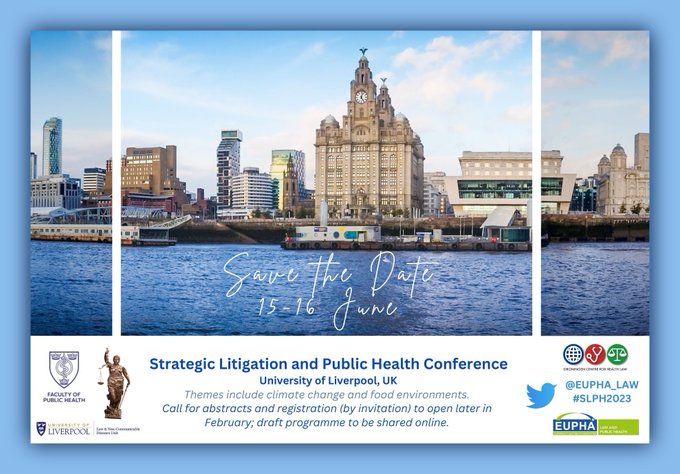
Strategic Litigation and Public Health Conference – save the date
15-16 June 2023, Liverpool, UK
EUPHA’s annual activity report 2022 published
Every year, EUPHA publishes an overview report of its work. The 2022 report is now available on our website in two formats: an 8-page summary highlighting key activities and achievements, and a full report with a comprehensive overview of all the EUPHA work carried out last year. Highlights of 2022 include the many activities of EUPHA and the EUPHA sections at the 15th Public Health Conference in Berlin, with a record number of over 2,500 delegates attending; the fourth edition of the European Health Week with 254 events organised in 32 countries and 21 languages; the impact factor of our scientific journal, the European Journal of Public Health, increasing to 4.424; a range of advocacy activities including statements, responses to public consultations, and being represented in key European stakeholder and advisory groups; and our increased visibility on social media.
EUPHA’s response to consultation on mental health
EUPHA and EUPHA Public mental health section have responded to the European Commission’s public consultation on ‘A comprehensive approach to mental health’. EUPHA’s members have identified mental health as a top priority for public health. EUPHA therefore welcomes and values the approach to put mental health in the spotlight of interest of policy makers in the European Union. However, EUPHA urges the Commission to apply a systemic public health perspective, including a life course approach. Read more.
|
3. European Public Health Week
Only three months to go until this year’s European Public Health Week (EUPHW). Might not seem like only but we all know that May will come in no time. So, make sure to mark your calendars between May 22nd and 26th, for a week packed full of interesting events. Also, please consider getting actively involved.
The 2023 European Public Health week and its sub-themes
The overarching theme of this year’s fifth in a row, European Public Health Week is “Global issues, local actions”.
Each day of the 2023 European Public Health Week will focus on a different sub-theme:
|
4. European Public Health Conference
16th EUROPEAN PUBLIC HEALTH CONFERENCE Dublin 8 – 11 November 2023
OUR FOOD, OUR HEALTH, OUR EARTH: A SUSTAINABLE FUTURE FOR HUMANITY
Abstract submission is open
Abstract submission for the in person 16th EPH Conference 2023 is open until 1 May 2023, 18:00 CET. Abstracts are invited for workshops, oral presentations, pitch presentations and ePosters. All sessions will be 60 minutes. Do not miss the opportunity to be recognized for your hard work. Learn from each other and share your knowledge with others. More information.
Win a waiver for the next EPH Conference
Submit an abstract for Dublin 2023 and win a waiver for the next EPH Conference. Each year the EPH Conference offers a prize for the best single abstract. The prize is determined by the scoring of the EPH Conference International Scientific Committee. The winner will be awarded a certificate and waiver of registration fees for the next EPH Conference in Lisbon.
Take part in the ‘Ference Bojan Young Investigators Aware’ Competition
The best five abstracts, submitted by young researchers (under 35y), will be presented in the Ferenc Bojan Young Investigators Award session. The Ferenc Bojan session is an oral session, but with a jury consisting of experienced researchers to select the best abstract/ presentation combination. The winner will be awarded a certificate and waiver of registration fees for the next EPH Conference in Lisbon. Read more.
Abstract tutoring programme
Do you need help with your abstract? In collaboration with EUPHAnxt we provide an Abstract Tutoring Programme offering an opportunity for young and/or less experienced abstract submitters to receive feedback from experienced reviewers. Check for more details here.
Registration
Registration for the 16th EPH Conference in Dublin opens 1 April 2023. Registration fees will be announced shortly on our website.
Conference venue
The 16th EPH Conference will be held in The Convention Centre Dublin. The CCD is one of Europe’s most environmentally-friendly venues. In 2021, the CCD secured ISO 20121 accreditation, which is a recognised international accreditation that demonstrates commitment to running sustainable events. With a structured approach addressing climate change, waste and biodiversity, The CCD is committed to achieving its sustainability vision. Read more.
|
5. EUPHA members update
EUPHA supports advocacy of its member UK Faculty of Public Health on Child Food Insecurity
The UK’s public health leaders have written to Prime Minister Rishi Sunak outlining three key actions to tackle child food poverty and help support a healthy population and productive economy. The letter, headed by the Faculty of Public Health, the Association of Directors of Public Health, the Royal Society for Public Health, and the School and Public Health Nurses Association, has received widespread support from Parliamentarians and third-sector organisations, including EUPHA. The letter calls on the Prime Minister to support the health and development of children in the UK by expanding access to Free School Meals, the National School Breakfast Programme, and the Healthy Start scheme. Read more.
|
6. European Journal of Public Health
Volume 33, Issue 1, February 2023
EDITORIALS
|
7. Call for proposals, job opportunities
Request for proposals: Hosting the European Observatory Venice Summer School 2023
The World Health Organization (WHO) invites vendors to submit their best offer to Request for Proposals 2023/EURO/OBS/0001.
Scientific Officer Communicable Diseases Prevention and Control
Applications are invited for this Contract Agent post at the European Centre for Disease Prevention and Control (ECDC). More information is available here.
|
8. Interesting news
Closing report: Boosting the development of medicines for children
Regulators in the European Union (EU) have taken several initiatives in the past four years to increase the efficiency of paediatric regulatory processes and boost the development of medicines for children. These achievements are highlighted in the closing report of the EMA and European Commission (EC) action plan on paediatrics.
For more details please check out the report here.
Health System Summary: Estonia, Italy, Austria and Germany
Health System Summaries that are published by the European Observatory on Health Systems and Policies are stand-alone, concise documents summarizing the main elements of a country’s health system in an engaging, policy-relevant way. They analyse core evidence and data on the organization, financing and delivery of health care. They also provide insights into key reforms and the varied challenges testing the performance of the health system. The four latest summaries are: Estonia, Italy, Austria and Germany.
Energy poverty – a mini documentary
Over the last decade, Brest métropole (FR) has fully engaged in the fight against fuel poverty, including at European level via the Climate Active Neighbourhoods (CAN) Interreg project. Watch the short video here.
Extension of HPV vaccination programme to boys in the Netherlands
In the Netherlands, human papillomavirus (HPV) vaccination was introduced in 2010 in the national immunization programme, targeted towards adolescent girls in the year they turned 13 years old. In 2022, the HPV vaccination programme was extended to boys, with the first round of vaccinations held in March and April 2022. Learn more here.
European healthcare professionals unite for the future of vaccination
At the beginning of this year, nearly 100 experts from across Europe gathered to discuss European and national vaccination policies and healthcare professionals’ role in increasing vaccine confidence and uptake. More information on this event is available here.
|
9. Upcoming courses and conferences
|
10. Interesting publications
E-cigarette manufacturers’ compliance with clinical trial reporting expectations: a case series of registered trials by Juul Labs
BMJ | Tobacco Control | January 2023
High drug prices are not justified by industry’s spending on research and development
BMJ | February 2023
The EU has a global health strategy: the challenge will be in the implementation
The Lancet | Comment |February 2023
The impact of COVID-19 on psychiatric and mental health services in Europe: suffering experienced by professionals
BMC | Health services } November 2022
Use of natural experiments to evaluate public health policy
The Lancet | Public Health | March 2023
Measuring the Burden of Infodemics: Summary of the Methods and Results of the Fifth WHO Infodemic Management Conference
JMIR | Infodemiology | February 2023
|
11. European Commission news
Parliament sets up new Public Health subcommittee
The new Public Health subcommittee of the European Parliament, established under the umbrella of the Committee on the Environment, Public Health and Food Safety (ENVI), will comprise 30 members. It will deal with programmes and specific actions in the field of public health, pharmaceutical and cosmetic products, health aspects of bioterrorism, the European Medicines Agency, and the European Centre for Disease Prevention and Control. Learn more here.
Europe’s Beating Cancer Plan: Commission presents first Country Cancer Profiles under the European Cancer Inequalities Registry
On World Cancer Day, 4 February, the Commission and the Organisation for Economic Co-operation and Development (OECD) present the first Country Cancer Profiles under the European Cancer Inequalities Registry for all EU Member States, Norway and Iceland.
Factsheet – Europe’s Beating Cancer Plan: Supporting actions to reduce inequalities
View the factsheet here.
First meeting of the Public Health Expert Group sub-group on mental health
The sub-group on mental health under the aegis of the new Public Health Expert Group (PHEG) held a first virtual meeting on 14 February 2023. It was chaired by DG SANTE and attended by the representatives of 23 EU Member States and Norway, together with Commission services, the World Health Organisation (WHO) and the Organization for Economic Co-operation and Development (OECD).
The objective was to inform Member States on the mandate for the new sub-group on mental health, provide an update on the ongoing work on a comprehensive approach to mental health, and present the draft WHO survey on mental health capacity building needs. Member States were invited to provide feedback and share national priorities and challenges in the field of mental health. Read the flash report here.
|
12. European Centre for Disease Prevention and Control news
Eurosurveillance – Volume 28, Issue 8, 23 February 2023
Rapid communication
Eurosurveillance – Volume 28, Issue 7, 16 February 2023
Rapid communication
Eurosurveillance – Volume 28, Issue 6, 09 February 2023
Surveillance
Eurosurveillance – Volume 28, Issue 5, 02 February 2023
Editorial
|
13. WHO news
Statement by WHO Euro Regional Director – Ukraine 1 year on: this is not the time to let fatigue win
“I urge a continued backing of Ukraine’s courageous people, and solidarity with its formidable health workforce. I can assure you that WHO will continue to stand strong alongside them, delivering health for all, for as long as it takes. This is not the time to let fatigue win.” Read the full statement here.
One-third of people in prison in Europe suffer from mental health disorders
New report on prison health in Europe highlights a good COVID-19 response, but raises issues of overcrowding, suicide rates and deficient mental health services.
Improving breast cancer survival. A new framework for action
In too many countries, the majority of women are diagnosed too late, multidisciplinary treatment and follow-up care are suboptimal, and supportive and palliative care remain critically underdeveloped. Vulnerable groups and women with lower education and income are more likely to be diagnosed late and have lower survival rates. These inequities can be bridged, but it will require systematic improvements.
Risk communication of ambient air pollution in the WHO European Region: review of air quality indexes and lessons learned
According the the World Health Organization, 99% of the world’s population is now breathing polluted air. Air pollution kills around 7 million people each year across the globe, and 90% of those affected live in low- & middle-income countries. See the report from the WHO Air quality and health team.
|
|
|
|
Unsubscribe
If you would like unsubscribe from the EUPHA newsletter then please click here.
|