 |
The European Public Health Association Newsletter – February 2022 |
1. Editorial
Amidst great turmoil in Ukraine we welcome you to our February newsletter. EUPHA put out a statement on 25 February with regards to the invasion. You can read the statement in the EUPHA update.
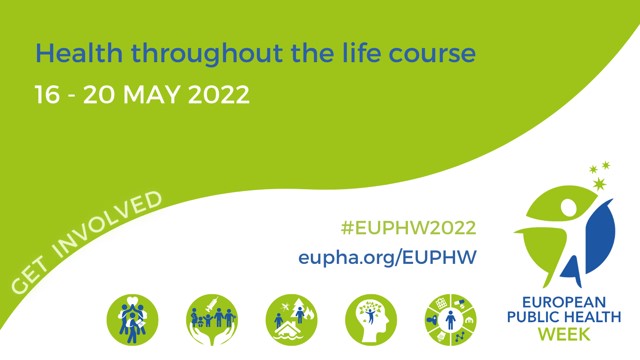
We are pleased to announce the 4th edition of our European Public Health Week and hope that many of you are planning to actively participate in this week (16-20 May).
The European Public Health Conference 2022 is planned in Berlin, Germany from 9-12 November. Abstract submission will open tomorrow morning and we hope many of you will submit their work and research.
Furthermore we have EUPHA updates, including the published articles in our EJPH and news from our members. And as always we provide updates from WHO Europe, the European Commission and ECDC.
Wishing you pleasant reading,
Iveta Nagyova, EUPHA president, and Dineke Zeegers Paget, EUPHA executive director
|
2. EUPHA update
Health is at stake in the Ukraine invasion
EUPHA unreservedly condemns the invasion of Ukraine by armed forces. As a public health organisation, it notes that the invasion poses important threats to health in the immediate future and the longer term.
https://eupha.org/repository/advocacy/EU…
EHMA – EUPHA Statement on Strengthening EU’s competitiveness in health
EUPHA and EHMA welcome the study on ‘EU’S PATH TO COMPETITIVENESS: How Digital, Energy and Health can lead the Way Forward’ (I-Com), presented in a digital symposium on 11 January 2022 by the Institute of Competitiveness.
If your organisation wishes to support this statement, please send your logo to [email protected]
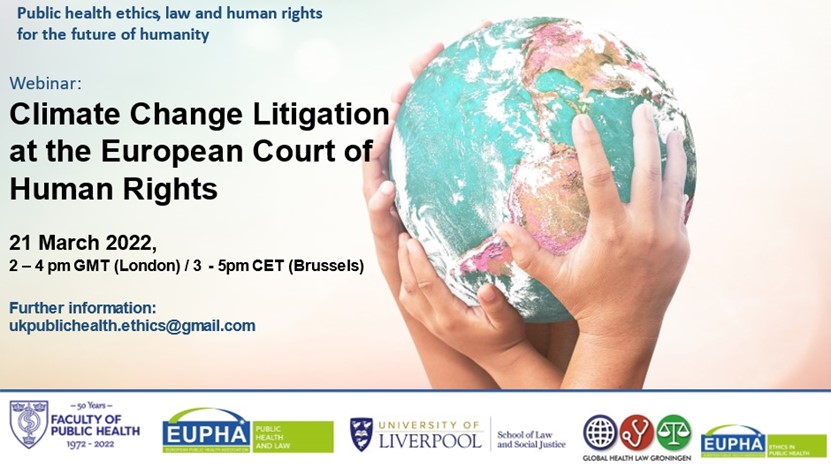
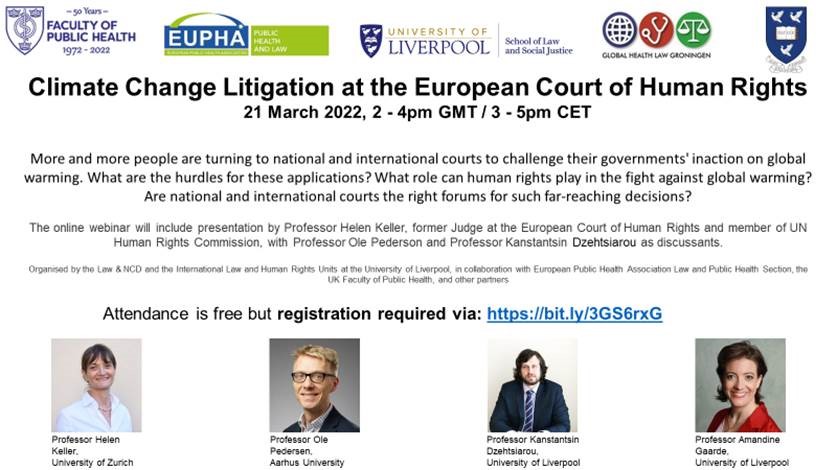
Climate Change Litigation at the European Court of Human Rights
This is to inform and invite you to an on-line webinar on
Attendance is free but registration required via: https://bit.ly/3GS6rxG
Joint call to MEPs to protect the strength of the BECA report during plenary vote
In a joint letter initiated by the European Chronic Disease Alliance and supported by EUPHA, organisations express their continued support to the report of the special committee on “Strengthening Europe in the fight against cancer” and ask MEPs to adopt it without compromising its content.
https://alliancechronicdiseases.org/join…
|
3. European Public Health Week
The preparations for the European Public Health Week are in full swing.
|

4. European Public Health Conference
15TH EUROPEAN PUBLIC HEALTH CONFERENCE, 9 – 12 NOVEMBER 2022
STRENGTHENING HEALTH SYSTEMS: IMPROVING POPULATION HEALTH AND BEING PREPARED FOR THE UNEXPECTED’.
WELCOME TO BERLIN 2022
ABSTRACT SUBMISSION IS OPEN
ABSTRACT MENTORING PROGRAMME
REGISTRATION
THEME AND PROGRAMME
CONFERENCE VENUE
|
5. EUPHA members update
Journal of Public Health Special Issue to mark the 50th Anniversary of the UK Faculty of Public Health: A call for papers
This year we celebrate 50 years of the UK Faculty of Public Health (formerly the Faculty of Community Medicine). The UK has a proud history of public health from 19th Century pioneers such as Edwin Chadwick and John Snow to modern leaders such as Richard Doll, Michael Marmot and many others. The Faculty of Public Health has been and is an important part of the public health landscape since its inception in 1972 as the standard setting body for public health specialists, and a source of knowledge and guidance around public health, and advocacy for public health nationally and globally. |
6. European Journal of Public Health
EDITORIALS
COMMENTARIES
SOCIAL DETERMINANTS
MENTAL HEALTH
WORK AND HEALTH
PHYSICAL ACTIVITY
SMOKING
COVID-19
CORRIGENDUM
Corrigendum to: SARS-CoV-2 outbreaks on Danish mink farms and mitigating public health interventions
ERRATUM
EUROPEAN PUBLIC HEALTH NEWS
Thank you
|
7. Call for proposals, job opportunities
EHMA is recruiting
The European Health Management Association is recruiting for the following positions:
Deadline for submitting your application: 7th March, 10.00 am. |
8. Interesting news
Public Health and Care Research Leadership Programme
UMIO proudly partners with The Netherlands School of Public Health and Care Research (CaRe), Netherlands Institute for Health Sciences (NIHES) at Erasmus MC, and Cambridge Institute of Public Health (CIPH) at the University of Cambridge to offer a second edition of the Public Health and Care Research Leadership Programme, with the next cohort starting in July 2022.
New website by Wemos provides overview and review of initiatives for access to medical products against Covid-19
Wemos | 9 February 2022
Make sure to have a look at this new tool, and to spread the word!
Work-related cancer in the centre of attention on World Cancer Day
Cancer is one of the biggest health concerns for European workplaces. According to the Roadmap on Carcinogens annually more than 100,000 people die because of work-related cancer.
EU-OSHA is committed to finding ways to better identify occupational cancer risk factors. For this, the fieldwork of the Workers’ exposure survey is carried out in September 2022 and first results are to be published in 2023.
https://osha.europa.eu/en/highlights/wor…
Covid-19: WHO efforts to bring vaccine manufacturing to Africa are undermined by the drug industry, documents show
The BMJ | Investigation / 9 February 2022
https://www.bmj.com/content/376/bmj.o304
PHIRI Rapid Exchange Forum
PHIRI, the Population Health Information Research Infrastructure, organizes every two weeks a Rapid Exchange Forum (REF) on COVID-19 activities. In this one hour meeting, the participants belonging to European public health institutes, ministry of health or research and universities answer and discuss the experiences in their own countries on specific questions related to COVID-19 measures submitted until 24 hours prior the start of the meeting.
You can access the minutes of those meetings and have a look at the above-mentioned questions on PHIRI’s website.https://www.healthinformationportal.eu/r…
Recommendations for a Europe’s Beating Cancer Plan inclusive of persons with disablities
European Disability Forum | Position paper | 22 February
https://webgate.ec.europa.eu/hpf/documen…
Campaigning for Specialist Nurses (ESNO)
Looking back at the Economics of Ageing Spotlight Series
Organiser: European Observatory on Health Systems and Policies
|
9. Upcoming courses and conferences
|
10. Interesting publications
The dawn of digital public health in Europe: Implications for public health policy and practice
The Lancet Regional Health Europe | Viewpoint | 2 February 2022
We need a public health approach to loneliness
The BMJ | Editorial | 9 February 2022
Gender and Social Inequalities in Awareness of Coronary Artery Disease in European Countries
International Journal of Environmental Research and Public Health | February 2022
https://www.mdpi.com/1660-4601/19/3/1388
Health system resilience and health workforce capacities: comparing health system responses during the COVID-19 pandemic in six European countries
https://doi.org/10.1002/hpm.3446
Estimating the potential for global dissemination of pandemic pathogens using the global airline network and healthcare development indices
Nature | Article | 23 February 2022
https://www.nature.com/articles/s41598-022-06932-y
COVID-19: talk of ‘vaccine hesitancy’ lets governments off the hook
Nature | Commentary | 22 February 2022
https://www.nature.com/articles/d41586-022-00495-8
Human rights in pandemics: criminal and punitive approaches to COVID-19
The BMJ Global Health | Analysis | 19 February 2022
https://gh.bmj.com/content/7/2/e008232
A framework for the promotion of ethical benefit sharing in health research
The BMJ Global Health | Practice | 10 February 2022
https://gh.bmj.com/content/7/2/e008096?rss=1
Recognising the elephant in the room: the commercial determinants of health
The BMJ Global Health | Commentary | 4 February 2022
https://gh.bmj.com/content/7/2/e007156?rss=1
Why the new normal might be the old normal—but worse
The BMJ | Editor’s choice | 17 February 2022
https://www.bmj.com/content/376/bmj.o398
Effectiveness of contact tracing in the control of infectious diseases: a systematic review
The Lancet | Article | 15 February 2022
https://www.thelancet.com/journals/lanpub/article/PIIS2468-2667(22)00001-9/fulltext
The prevalence of loneliness across 113 countries: systematic review and meta-analysis
The BMJ | Research | 9 February 2022
https://www.bmj.com/content/376/bmj-2021-067068
Covid-19: WHO efforts to bring vaccine manufacturing to Africa are undermined by the drug industry, documents show
The BMJ | Featured investigation | 9 February 2022
https://www.bmj.com/content/376/bmj.o304
Thousands of girls as young as 11 in England hiding signs of ‘deep distress’
The Guardian | 28 February 2022
|
11. European Commission news
European Health Union: HERA launches first work plan with €1.3 billion for preparedness and response to health emergencies in 2022
The new European Health Emergency Preparedness and Response Authority (HERA) presented its first annual work plan on 10 February, which will have a budget of €1.3 billion in 2022 to prevent, prepare for and rapidly respond to cross-border health emergencies. Following the adoption of the 2022 work plan by the HERA Board, HERA can now start implementing actions to strengthen preparedness and response capabilities within the EU, address vulnerabilities and strategic dependencies and contribute to reinforcing the global health emergency architecture.
Speech by Commissioner Kyriakides at the Joint Conference of Foreign Ministers and Health Ministers
Commissioner Stella Kyriakides delivered a speech at the Joint Conference of Foreign Ministers and Health Ministers on 9 February, addressing different ways to further support low and middle income countries.
Webinar on Climate change and Health: Addressing climate change impacts on health through national policies
16 March, 10.00 – 11.15 CET
https://ecconf.webex.com/mw3300/mywebex/…
World Rare Disease Day: Statement by Commissioner Stella Kyriakides
Ahead of World Rare Disease Day on 28 February, Commissioner for Health and Food Safety, Stella Kyriakides, made a statement highlighting the key role of a European Health Union and the work of the European Commission and the French Presidency on the response to rare diseases.
https://ec.europa.eu/commission/presscorner/detail/en/statement_22_1335
Press release on the EU participation to the small group of foreign ministers meeting to coordinate enhanced COVID-19 response
In the COVID-19 Global Action Meeting, convened by US Secretary of State Blinken and gathering the EU, represented by Commissioner Urpilainen, and other partner countries, participants discussed yesterday a ‘COVID-19 Global Action Plan’.
The objective is to help coordinate actions and mobilise resources in six priority areas in relation to the global COVID-19 response to bring an end to the pandemic by the end of 2022: get shots in arms, bolster supply chain resilience, address information gaps, support health care workers, ensure availability of treatments and testing where it is most needed and strengthen the global health security architecture.
https://ec.europa.eu/commission/presscorner/detail/en/ip_22_1061
Joint Statement ahead of the International Day of Zero Tolerance for Female Genital Mutilation
“This horrific practice […] has very serious negative consequences that affect the physical and mental health of women and girls, including infections, infertility and chronic pain. This practice puts the lives and wellbeing of thousands of women and girls at risk and in some cases it can even lead to their death.”
https://ec.europa.eu/commission/presscorner/detail/en/statement_22_727
Remarks by Commissioner Kyriakides at the event ‘Ensuring Equal Access to All: Cancer in Women – Europe’s Beating Cancer Plan’
https://ec.europa.eu/commission/presscorner/detail/en/speech_22_747
Europe’s Beating Cancer Plan: New actions to increase access to cancer prevention, early detection, treatment and care
The Commission has launched four new EU Cancer Plan actions to support Member States in addressing inequalities, improving screening and vaccination against HPV, and supporting persons who have experienced cancer:
https://ec.europa.eu/commission/presscorner/detail/en/ip_22_702
|
12. European Centre for Disease Prevention and Control news
Eurosurveillance – Volume 27, Issue 5, 03 February 2022
Rapid communication
Eurosurveillance – Volume 27, Issue 6, 10 February 2022
Rapid communication
Eurosurveillance – Volume 27, Issue 7, 17 February 2022
Rapid communication |
13. WHO news
WHO/Europe statement on Ukraine
24 February 2022
Planning the health-care workforce: what new policy tools and resources are available?
How can countries best be supported to answer key policy questions relating to health and care workers? With just over a quarter of people in the WHO European Region living in rural or remote areas, how can strong, multidisciplinary teams be built to deliver primary health care based on local needs, as well as national priorities? Answers to these questions were provided at a WHO Healthy Settings webinar on 27 January 2022, which focused on new tools and resources available for planning the health workforce.
Food marketing exposure and power and their associations with food-related attitudes, beliefs and behaviours: a narrative review
This report presents the outcomes of a narrative review conducted to update an earlier descriptive review published by WHO in 2009 on the extent, nature and effects of food marketing. This review extends the findings of the 2009 WHO review by adding evidence and perspectives on more contemporary types of marketing, reflecting the growth in internet use and food marketing via digital and social media over the last decade. Read the report
WHO launches fact sheet series on environmental health inequalities in Europe
To document and report on the magnitude of inequalities in environmental exposure within countries, WHO has launched the first 7 of a series of fact sheets on environmental health inequalities in relation to housing conditions and access to drinking-water and sanitation.
New WHO report highlights scale of childhood cancer inequalities in the European Region
On International childhood Cancer day, WHO released a report that, for the first time, sets out the evidence on childhood cancer inequalities in the Region, and examines the patterns that emerge at national and regional levels of childhood cancer incidence, patient and caregiver experiences, and short- and long-term outcomes for patients.
New WHO signature initiative shows raising alcohol taxes could save 130’000 lives per year
Across the Region, taxes on the sale of alcohol are lower than taxes on tobacco. To enhance the untapped power of health taxes, the WHO Regional Director for Europe’s Advisory Council on Innovation and Noncommunicable Diseases (NCD Advisory Council) has proposed a new signature initiative on taxation for countries to consider in their fiscal policies.
How the marketing of formula milk influences our decisions on infant feeding
This report summarizes the findings of a multicountry study examining the impact of breast milk marketing on infant feeding decisions and practices, which was commissioned by WHO and UNICEF. The research study – the largest of its kind to date – draws on the experiences of over 8500 women and more than 300 health professionals across eight countries. Download the report
https://www.who.int/publications/i/item/…
New report on tuberculosis, HIV and viral hepatitis services for refugees and migrants across the WHO European Region
A new WHO report finds out that international recommendations on effective services to treat tuberculosis (TB), HIV and viral hepatitis for refugees and migrants lack implementation across the WHO European Region, who are still disproportionately affected by those diseases.
Report of the WHO global technical consultation on public health and social measures during health emergencies
The global technical consultation on public health and social measures (PHSM) during health emergencies took place from 31 August to 2 September 2021. The consultation focused on reviewing the existing evidence and learning from experiences with implementing PHSM during the COVID-19 pandemic and this reports summarises its key outcomes.
https://www.who.int/publications/i/item/9789240043213
Caring for those who care: guide for the development and implementation of occupational health and safety programmes for health workers: executive summary
This guide provides an overview of the key elements of occupational health and safety programmes for health workers at national, subnational and facility levels, as well as advice for the development and implementation of such programmes. Full guide
|
|
Unsubscribe
If you would like unsubscribe from the EUPHA newsletter then please click here.
|