 |
The European Public Health Association Newsletter – December 2025 |
|
Newsletter – December 2025
|
1. Editorial
2025 in review: wins, losses, and what they tell us about public health today
As we close 2025, taking stock of the year means being honest about both progress and setbacks – and about what it took to sustain public health when conditions were far from favorable. This was not an easy year for public health — in Europe or globally. It was shaped by political tensions, financial uncertainty, and growing pressure on evidence, institutions, and professionals. For EUPHA, it was also a year of resilience, adaptation, and collective effort.
In a year when EU4Health operating grants were withdrawn, EUPHA maintained its core activities, supported its Sections and networks, and continued to provide a trusted platform for exchange between research, policy, and practice. This was only possible because of the commitment of our members, partners, and staff — and because collaboration remained at the heart of how we work.
The 18th European Public Health Conference in Helsinki was a clear example of this strength. With 3,000 participants, the Conference sold out and brought together the public health community from across Europe and beyond to share evidence, challenge assumptions, and debate the future of health. At a time of uncertainty, the Conference reaffirmed the value of coming together — not just to present results, but to connect, learn, and build common ground.
Throughout the year, EUPHA Sections remained highly active, addressing issues such as mental health, healthy environments, workforce development, digitalisation, and misinformation. Demand for training, skills development, and professional exchange continued to grow, reflecting a shared understanding that resilient health systems depend on a skilled, supported, and multidisciplinary public health workforce.
Public health debates became more explicitly political — not in a partisan sense, but in recognizing power, interests, and structural determinants of health. across EUPHA activities reflected a shift away from purely technical solutions toward more systemic approaches, including Health in All Policies and the commercial determinants of health.
But 2025 also brought significant losses
In several countries, public health institutions faced political pressure, reduced mandates, or challenges to scientific independence. The space for evidence-informed policymaking narrowed in some contexts, while misinformation and polarization further eroded public trust. These dynamics disproportionately affected already vulnerable populations, widening inequalities and increasing unmet needs, particularly in mental health and social support.
Perhaps most concerning, 2025 made clear that public health is no longer simply under-resourced; it is increasingly contested. Expertise, institutions, and even the legitimacy of collective action for health are being questioned in ways that go beyond normal policy debate.
What this means for EUPHA – and for 2026
This is precisely why EUPHA’s role — and the role of its members — matters. Public health today requires not only evidence and competence, but also coordination, visibility, and the courage to engage politically when health is sidelined or instrumentalized.
As we move into 2026, we do so with realism and confidence: the challenges are real, but so is the strength of this community. Our task is to not only improve health outcomes, but to defend the conditions that make public health possible – together
Thank you for your engagement, resilience, and commitment throughout 2025.
We wish you a restful holiday period and a healthy start to 2026.
Dr. Tit Albreht, EUPHA President
|
2. EUPHA news
New CPD opportunity: An introduction to AI for healthcare and public health professionals
Artificial Intelligence (AI) is rapidly reshaping healthcare and public health — from improving diagnostics and clinical decision-making to strengthening surveillance systems and population health management. At the same time, many professionals feel underprepared to address the ethical, regulatory, and workforce challenges that come with integrating AI into practice.
To help bridge this gap, the Faculty of Nursing & Midwifery at the Royal College of Surgeons in Ireland (RCSI), supported by EUPHA, is launching a new Continuous Professional Development (CPD) programme: An Introduction to AI for Healthcare and Public Health Professionals.
About the pilot programme
Participants who complete the programme and the pre- and post-programme evaluation will receive 24 Continuing Education Units (CEUs).
Free pilot places – expressions of interest open
Expression of interest form (estimated completion time: 2–3 minutes)
Selected participants will be notified by email around 7 January 2026.
Further details about the programme are available in the brochure. Please note that the registration link and QR code in the brochure are not active for this pilot phase.
Section webinars: catch up on past events and what’s coming next
EUPHA Sections have been busy throughout 2025, hosting a wide range of webinars across key public health topics. If you missed any of these sessions — or would like to revisit them — recordings are available under past events on our website.
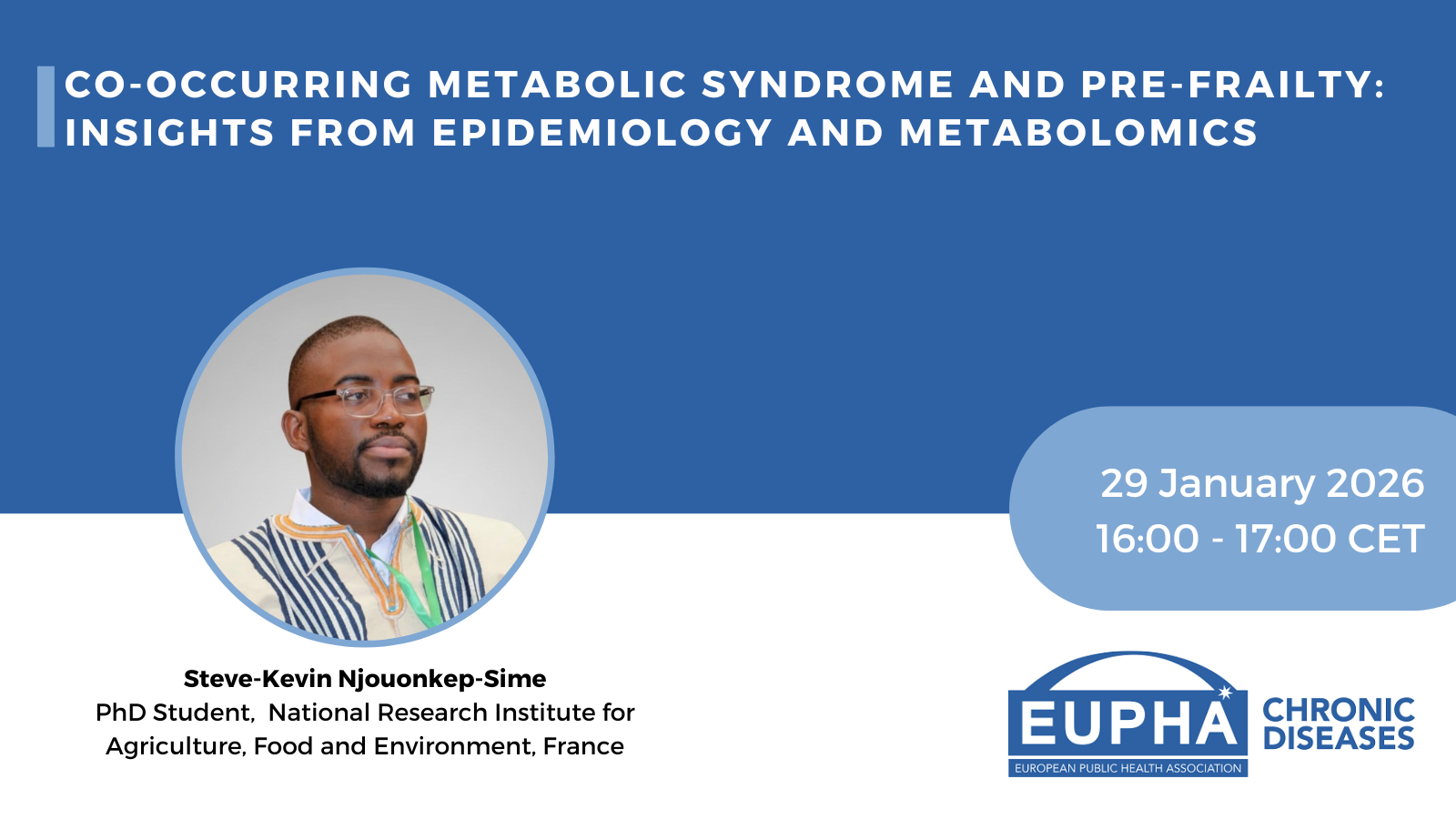
Looking ahead to 2026, our Sections already have a full calendar of activities planned. The first webinar of the year takes place in January and is organised by the Chronic Diseases Section.
As Europe’s population ages, chronic diseases and functional decline are becoming increasingly common. Pre-frailty — an early, more prevalent, and potentially reversible stage of frailty — offers a crucial window for prevention. At the same time, metabolic syndrome (MetS) is a major age-related condition and a strong risk factor for adverse cardiometabolic outcomes.
This webinar explores how MetS and pre-frailty co-occur and interact over time, drawing on new epidemiological and metabolomic research. Speakers will present findings from cross-sectional and longitudinal analyses, clustering approaches, and metabolomic profiling to shed light on shared biological mechanisms, including inflammation, insulin resistance, and oxidative stress. Together, these insights point toward improved risk stratification and more precise prevention strategies for older adults. Register for the webinar.
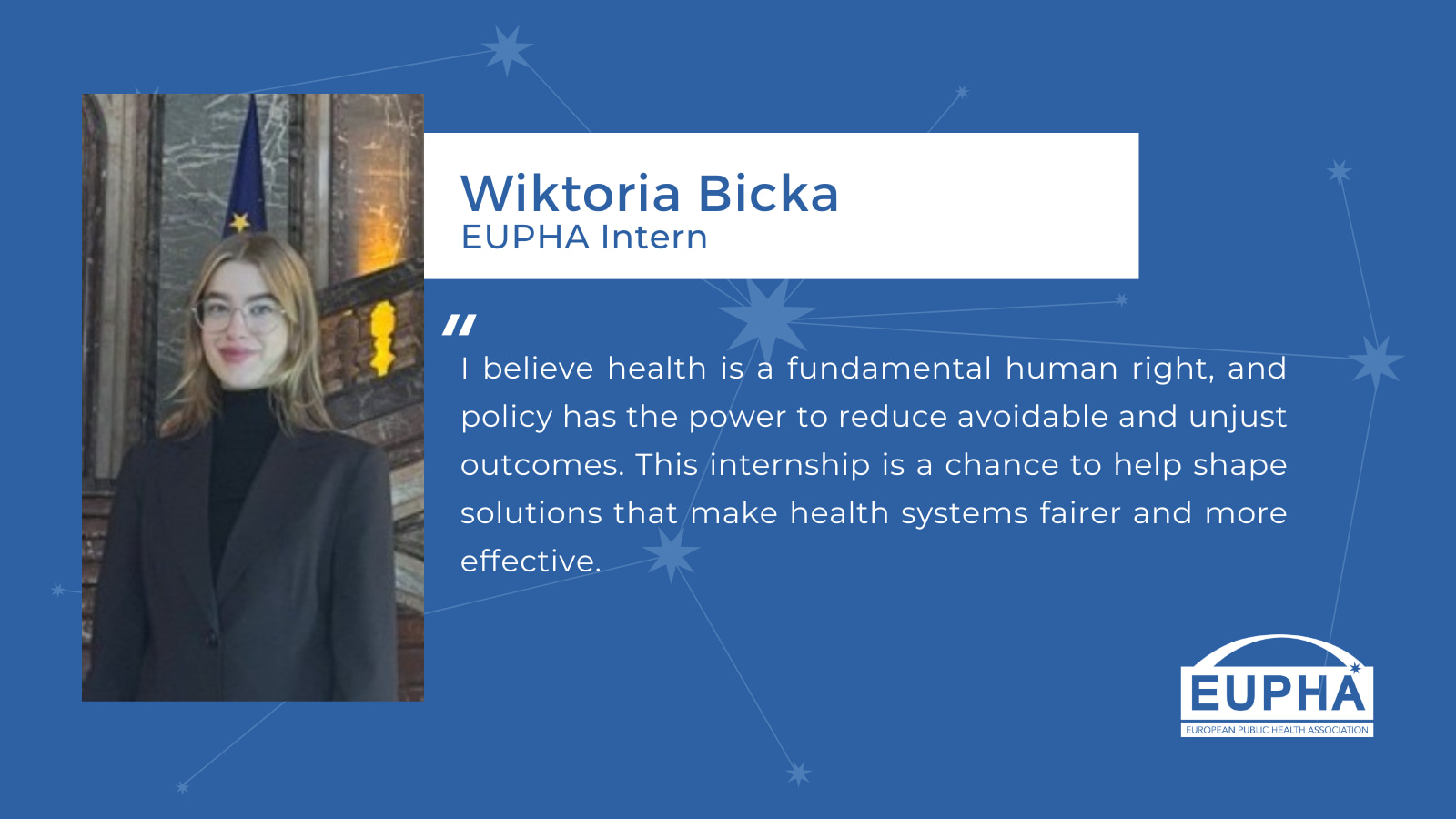
Meet our new intern: Wiktoria Bicka
We are pleased to welcome Wiktoria Bicka, who joined EUPHA this month as our new intern. Based in London (UK), Wiktoria will support a Healthy Food Healthy Planet–funded project, focusing on a structured literature review of policies that hold food companies accountable for the health and sustainability impacts of their products. Her work will help produce a clear, policy-relevant synthesis for European public health stakeholders working to create healthier food environments.
Alongside her internship, Wiktoria is completing an MSc in International Health Policy at the London School of Economics and Political Science, with interests spanning health system financing, performance, and evidence-informed policy—particularly in noncommunicable diseases and maternal health.
Wiktoria describes joining EUPHA as “a dream beginning to my career,” and we are delighted to have her on board. Read more about Wiktoria and her work on our website.
Austrian National Public Health Institute (GÖG) joins EUPHA
We are pleased to welcome the Austrian National Public Health Institute (Gesundheit Österreich GmbH, GÖG) as a new institutional member of the European Public Health Association (EUPHA).
Established by federal law on 1 August 2006, GÖG is the institution responsible for researching and planning public healthcare in Austria and serves as the national competence and funding centre for health promotion. GÖG is a public, non-profit limited liability company fully owned by the Republic of Austria, with the federal government—represented by the Ministry of Health—as its sole shareholder.
GÖG’s mission, strengthening public health through evidence-based research, policy support, and knowledge dissemination, closely aligns with EUPHA’s commitment to advancing public health across Europe by connecting research, policy, and practice.
By joining EUPHA, GÖG becomes part of a Europe-wide network of public health professionals and institutions working together to improve population health and well-being.
We warmly welcome the GÖG team and look forward to future collaboration within the EUPHA community.
Welcoming our new Section Presidents
EUPHA’s Sections are where much of our network’s expertise, collaboration, and momentum comes to life – thanks to the volunteers who lead them.
We’re pleased to announce and warmly welcome the newly appointed Presidents of the following Sections:
We’re grateful to each of you for stepping into these leadership roles and for supporting your Section’s community over the next two years—strengthening connections across research, policy, and practice, and helping EUPHA deliver impact through timely, relevant activities.
Other Sections are still completing their election processes. We look forward to announcing the remaining results in the new year.
EUPHA and COTEC sign MoU to strengthen public health across Europe
At the 18th European Public Health Conference in Helsinki last month, EUPHA and the Council of Occupational Therapists for the European Countries (COTEC) signed a Memorandum of Understanding, formalising a shared commitment to advancing public health across Europe.
The agreement sets a clear framework for collaboration on priority areas including health and care workforce development, healthy ageing, digital health and AI, early career engagement, and joint advocacy and communications. COTEC represents 33 national associations and more than 205,000 occupational therapists across Europe.
Reflecting on the significance of the partnership, Anu Söderström, COTEC President, noted:
EUPHA President Prof. Tit Albreht highlighted the strong alignment between the two fields:
Together, EUPHA and COTEC will work to strengthen policy influence, promote evidence-informed practice, and support a future-ready, person-centred health workforce.
Read more on our website.
New EJPH Supplement: Migration, Ethnicity, Race and Health — Themes and Highlights
A new open-access supplement of the European Journal of Public Health (Volume 35, Supplement 6, December 2025) brings together the key themes and scientific contributions from the Second World Congress on Migration, Ethnicity, Race and Health, held in September 2025 in Lisbon.
Under the theme “Migration as a Driver of a Healthy, Racism-Free, Multi-Ethnic World,” the Congress convened more than 540 participants from 60 countries. Across plenaries, workshops, oral sessions, and posters, contributors examined persistent health inequities linked to migration and ethnicity—and, critically, how to close them.
The supplement publishes abstracts from over 400 sessions, covering topics such as racism and xenophobia, human rights and access to care, refugee and asylum-seeker health, reproductive and mental health, intersectionality, and indigenous health. Newer areas—including climate change as a driver of migration, conflict and peace-building, decolonizing global health, and participatory approaches—feature strongly, reflecting a clear step forward in methodological quality and conceptual rigor.
Read the supplement (open access) online.
|

3. European Public Health Conference
Relive the EPH 2025 Opening Ceremony and Plenaries
Couldn’t attend the 18th European Public Health Conference in Helsinki—or want to revisit key moments? Recordings from the Opening Ceremony and several plenary sessions are now available to watch online.
The Opening Ceremony set the tone for the conference, reflecting on this year’s theme and the collective responsibility to invest in sustainable health and well-being across Europe. It brings together voices from across the public health community, offering context, inspiration, and a shared sense of purpose as the conference began.
Plenary recordings published so far capture timely discussions on some of today’s most pressing public health challenges, from mental health and youth well-being to trust in science and navigating misinformation. These sessions bring together leading experts and policymakers, offering evidence-informed perspectives and concrete calls to action.
Additional recordings—Plenary 4 and Plenary 5—will be published in early January, completing the full set of EPH 2025 plenaries.
Watch the recordings on YouTube.
Looking ahead to Bilbao: EPH 2026
Planning is already underway for the 19th European Public Health Conference, which will take place in Bilbao, Spain, at the Euskalduna Conference Centre, from 10–13 November 2026.
Under the theme Urban and global synergies: shaping the future of public health with climate resilience, equity and innovation, EPH 2026 will bring together the European and global public health community to explore how cities, regions, and countries can work together to address shared challenges and shape a more resilient, equitable future.
More information on the programme, abstract submission, and registration will be shared throughout 2026 on our website and LinkedIn. For now, mark your calendar and save the date.
|
4. Upcoming courses and conferences
|
5. Interesting publications
Effective communication and public engagement strategies to counter misinformation about infectious diseases
Effective communication and public engagement are essential components of infectious disease control, yet they remain underdeveloped in the field of immunology. This review explores how immunologists and scientists can contribute to countering misinformation and improving vaccine uptake through inclusive, culturally sensitive engagement. Drawing on historical and contemporary case studies, the authors examine how trust, cognitive biases, and community involvement shape public responses. They outline principles for designing trustworthy visuals, mitigating cognitive biases, and embedding context directly within graphics to prevent misinterpretation. Participatory approaches to data communication are shown to improve comprehension and trust, especially when co-developed with affected communities. Together, these domains—engagement, vaccine communication, and data presentation—form a foundation for resilient public health responses. By integrating immunological expertise with inclusive communication strategies, scientists can play a central role in fostering informed decision making and strengthening public cooperation in future outbreaks.
Read the article in full here.
Community health workers: a comparative assessment of capacities of a global policy approach in selected European health systems
Interest in community health workers (CHWs) and the benefits for health systems are growing globally, but research is focused on low- and middle-income countries and high-income Anglo-American countries. This comparative assessment focuses on community health systems and health and care workers as advocates and boundary spanners, aiming to connect global evidence to high-income European countries and assessing the capacities for transformative change. A qualitative comparative approach and case study design were chosen, aligning global expertise of the CHW pioneers, Brazil and South Africa, and selected European countries: Denmark, Germany, Netherlands, Portugal, Romania, UK/England. Case studies were collected in April/May 2025, drawing on country experts and secondary sources; thematic analysis was performed following an explorative interactive consensus-based procedure.
Read the article in full here.
Country health profiles – State of Health in the EU
The State of Health in the EU country health profiles provide a concise and policy-relevant overview of health and health systems in all EU countries, Iceland and Norway, emphasising the particular characteristics and challenges in each country. They are designed to create a means of mutual learning that support the efforts of countries in their evidence-informed policy making.
Each Country Health Profile provides a short synthesis of:
The profiles are the joint work of the European Observatory on Health Systems and Policies and the Organisation for Economic Co-operation and Development (OECD), in co-operation with the European Commission, as part of the 2024-2025 State of Health in the EU cycle.
Read the Synthesis Report 2025 or view each country’s profile.
|
|
Unsubscribe
If you would like unsubscribe from the EUPHA newsletter then please click here.
|