 |
The European Public Health Association Newsletter – April 2025 |
1. Editorial
Standing strong, speaking up, and celebrating public health together
As we navigate an increasingly complex public health landscape, one thing has never been clearer: we are stronger when we come together.
Across Europe, momentum is building behind our call to protect public health funding. Our EU4Health petition has already received encouraging support, and we are just getting started. The message is simple but urgent: European investment in public health must not only be protected but expanded. We encourage all of you—whether you’re a public health professional, advocate, or concerned citizen—to sign the petition, share it with your networks, and encourage your colleagues and communities to do the same. Your voice matters. Let’s get it heard.
As we say in the MEP Interest Group launched to drive action on health inequalities, prevention, and risk factors, many people may not be aware that only 1% of the EU health budget is currently used to support civil society organizations that work at the EU level to represent the voices of patients, healthcare professionals, and citizens. This funding, provided through operating grants, isn’t about short-term campaigns or national projects. It’s about ensuring that the EU remains open to people’s voices, especially when it comes to prevention and long-term health policy.
To put it in perspective: in 2024, just €9 million out of a €752 million EU health budget was allocated to these grants. The 2025 figures are not yet published, but this share has consistently been small — and yet it remains crucial. Without operating grants, there is no sustainable way for independent, public-interest organizations to participate in shaping EU health policies. We risk losing the grounded, diverse voices that help keep EU policymaking fair, inclusive, and truly European.
This growing engagement comes at an important moment. Protecting public health funding is not just about budgets — it’s about sustaining the community-driven work that strengthens Europe’s health systems. In just a few weeks, we’ll see this collective spirit in action during the European Public Health Week (EUPHW): a time to celebrate collaboration, innovation, and resilience in building healthier societies. Even in the face of economic and political challenges, EUPHW reminds us what’s possible when we unite around common goals.
From webinars on mental health and primary care reform to solidarity events supporting global public health science, this year’s program is both timely and inspiring. Just a few highlights:
Whether you’re joining a webinar, signing the petition, or simply talking about public health with a colleague, your engagement matters. These small actions—multiplied across Europe—are how change begins.
This month, we speak up for public health funding—and we celebrate what our community is capable of when we work together. Join us in both.
Dr. Tit Albreht, EUPHA President
|
2. EUPHA update
Upcoming EUPHA Section webinars
Our Sections continue to be busy, bringing together experts from across Europe and beyond to discuss key public health challenges, share insights, and explore solutions. Join upcoming sessions to stay informed and engage with the latest research and policy developments.
22 May, 16:00 – 17:00 CEST
This webinar will explore current debates on cancer screening in older adults, highlighting how individualized approaches may offer value beyond standard guidelines, supported by population-based research from Switzerland. Click here to register.
26 June, 16:00 – 17:00 CEST
Join Domitilla Marconi from the University of Siena, Italy as she discusses the national strategy behind the Italian Fund for Alzheimer’s and Dementia and its role in strengthening the public health response to dementia. Click here to register.
Upcoming webinar: fostering synergies for effective prevention strategies in health and care systems
5 May, 10:00 – 12:00 CEST
The webinar is part of the PROPHET project, a Horizon Europe initiative focused on personalized prevention, where EUPHA is proud to serve as a consortium member alongside partners from 12 countries.
Upcoming EUPHA Summer Schools in June 2025
EUPHA is excited to announce three engaging summer schools and conferences happening in June 2025. These events offer a unique opportunity for public health professionals, researchers, and students to deepen their knowledge, engage with experts, and explore new perspectives on critical public health topics. Read on to learn more about these upcoming events:
Dates: 2–6 June 2025
This summer school will focus on trauma-informed public health practices, an area of growing importance in improving mental health outcomes. Participants will explore approaches to resilience, the impact of trauma, and how trauma-informed care can be integrated into public health strategies.
Dates: 3–4 June 2025
This event will focus on institutionalising Health Impact Assessment (HIA) to better inform decision-making processes in Europe. Participants will learn how to implement HIA within different contexts to enhance public health policy.
Dates: 5–6 June 2025
This symposium will explore the societal and nutritional determinants of chronic diseases and the need for a paradigm shift in prevention strategies. It will feature both in-person and online participation.
European Journal of Public Health – April 2025 issue now available
We are pleased to announce the publication of the April 2025 issue (Volume 35, Issue 2) of the European Journal of Public Health. This edition offers a diverse range of articles addressing pressing public health topics across Europe and beyond.
Highlights from this issue include:
We invite you to explore the full issue and engage with the latest research shaping public health discourse. Access the April 2025 issue here.
EUPHA contributes to the evaluation of EFSA’s performance (2017–2024)
EUPHA has submitted input to the European Commission’s public consultation on the performance of the European Food Safety Authority (EFSA)—a key pillar of the EU’s food safety system. Developed in collaboration with EUPHA’s Food and Nutrition Section, our response draws on public health expertise to highlight strategic priorities for EFSA’s continued relevance and impact.
As Europe faces increasing pressures from climate change and geopolitical instability, the role of EFSA must evolve beyond risk assessment. EUPHA’s recommendations emphasize the importance of anticipatory action, stronger system-wide coordination, and meaningful engagement across sectors.
Key recommendations include:
Aligning food safety with broader health, environmental, and digital strategies
EFSA stands at a pivotal moment. Its ability to lead across disciplines and foster innovation will shape how Europe responds to emerging risks in the years ahead.
Securing public health in the EU’s next budget: why it matters
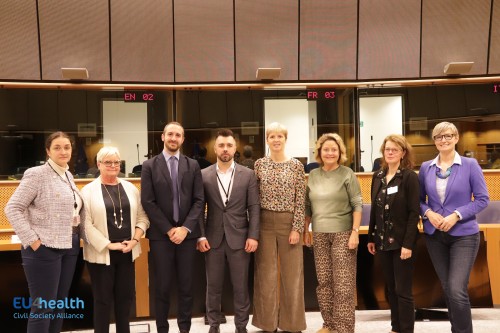
As discussions begin around the next Multiannual Financial Framework (MFF), the question of how public health will be funded takes on growing urgency. Earlier this month, EUPHA—represented by Marleen Bekker—joined more than 150 participants at the EU4Health Civil Society Alliance event at the European Parliament to make the case for stronger, long-term investment in health.
What’s at stake?
The COVID-19 pandemic made it clear: resilient health systems depend not only on resources, but also on public trust. The EU’s Global Health Strategy and Preparedness Union Strategy outline a vision for more resilient systems—but vision must be backed by adequate funding.
EUPHA highlighted key areas for action:
As the EU prepares for its next financial cycle, the values it was built upon – solidarity, equity, and shared responsibility – must be upheld. EUPHA continues to advocate for the Four E’s: Evidence, Empowerment, Equity, and Engagement.
With thanks to the panel, chaired by EPHA’s Milka Sokolović and EPF’s Anca Toma, and including Irene Norstedt (European Commission, DG RTD), Michele Calabrò (EUREGHA), and Marleen Kestens (European Heart Network).
Watch now: strengthening public health advocacy
In early April, EUPHA and ASPHER co-hosted a timely webinar: Strengthening Public Health Advocacy. The session responded to recent political discourse questioning WHO membership in several European countries – an issue that threatens the credibility of public health institutions globally.
The webinar brought together a strong panel of speakers to explore how national public health associations and schools of public health can respond to misinformation, defend evidence-based institutions, and advocate for continued support of the WHO.
Highlights from the webinar included:
If you missed it, the full recording is now available to watch.
|
3. European Public Health Week
Register now for the EUPHW hackathon: innovating for public health
EUPHA is thrilled to announce the launch of registration for the BrailleRap Hackathon, an exciting event where inclusive innovation takes center stage. This two-day event brings together innovators, public health professionals, and students to work on enhancing access to public health information and services through the assembly of open-source Braille embossers.
Date: 14-15 May
Registration: register by 5 May via our registration form.
What to expect:
The hackathon will conclude with a real-world testing phase, where visually impaired users will provide feedback to ensure the machines meet accessibility standards. Don’t miss this opportunity to contribute to meaningful innovation in public health! For more information visit our website.
Explore the EUPHW 2025 events calendar – get involved!
With EUPHW 2025 approaching fast, the EUPHW events calendar is now live! With activities happening across Europe and online, this is your chance to discover events aligned with this year’s themes and get involved in the movement for better public health.
From expert-led webinars to local awareness campaigns and community workshops, the calendar features a diverse mix of events organized by public health professionals, institutions, and civil society groups.
EUPHW 2025 guidebook now available – submit your event by 5 May
EUPHA is excited to announce the release of the EUPHW 2025 Guidebook, now available to support all event organisers and participants preparing for the upcoming European Public Health Week (12–16 May 2025).
This practical guide offers a comprehensive resource for planning and promoting your activities, ensuring that your event aligns with the overall goals of the week. The guidebook includes:
Whether you’re planning a webinar, panel discussion, workshop, or awareness campaign, this guidebook will help you create a meaningful and well-coordinated activity.
The deadline for event submissions is 5 May. If you’re organising an event during EUPHW 2025, we encourage you to register it as soon as possible.
Download the guidebook and submit your event today!
Promotional toolkit now available
The promotional toolkit for European Public Health Week 2025 is now live. It includes a range of ready-to-use materials to help individuals and organisations promote this year’s theme: Innovation for Resilience: Shaping a Sustainable Future.
The toolkit features:
Whether you’re hosting an event, raising awareness online, or promoting public health within your community or organisation, the toolkit offers resources to support your efforts.
|
4. European Public Health Conference
Abstract submissions close tomorrow – what comes next?
The deadline to submit your abstract for the 18th European Public Health Conference in Helsinki, Finland is just around the corner—1 May. If you’re planning to contribute, now is the time to act as there will be no deadline extension.
We’ve already received a record number of submissions, underscoring the strength and commitment of the public health community across Europe. This year’s conference promises to be a dynamic space for sharing knowledge, sparking new ideas, and shaping the future of public health.
After the deadline, all submissions will be reviewed by 4–5 members of the International Scientific Committee, based on their topic area. The results will then be processed and presented at the meeting of the EPH Conference Executive Board, where decisions about acceptance or rejection will be taken. Abstract authors will be notified of outcomes in the second week of June.
Submit your abstract here!
Conference registration is open!
Don’t miss your chance to attend the 18th European Public Health Conference in Helsinki this November. Early bird registration is open until 15 July—register now to secure your spot at Europe’s leading public health event at the best rate. For more information on registration fees and conference details, visit our website.
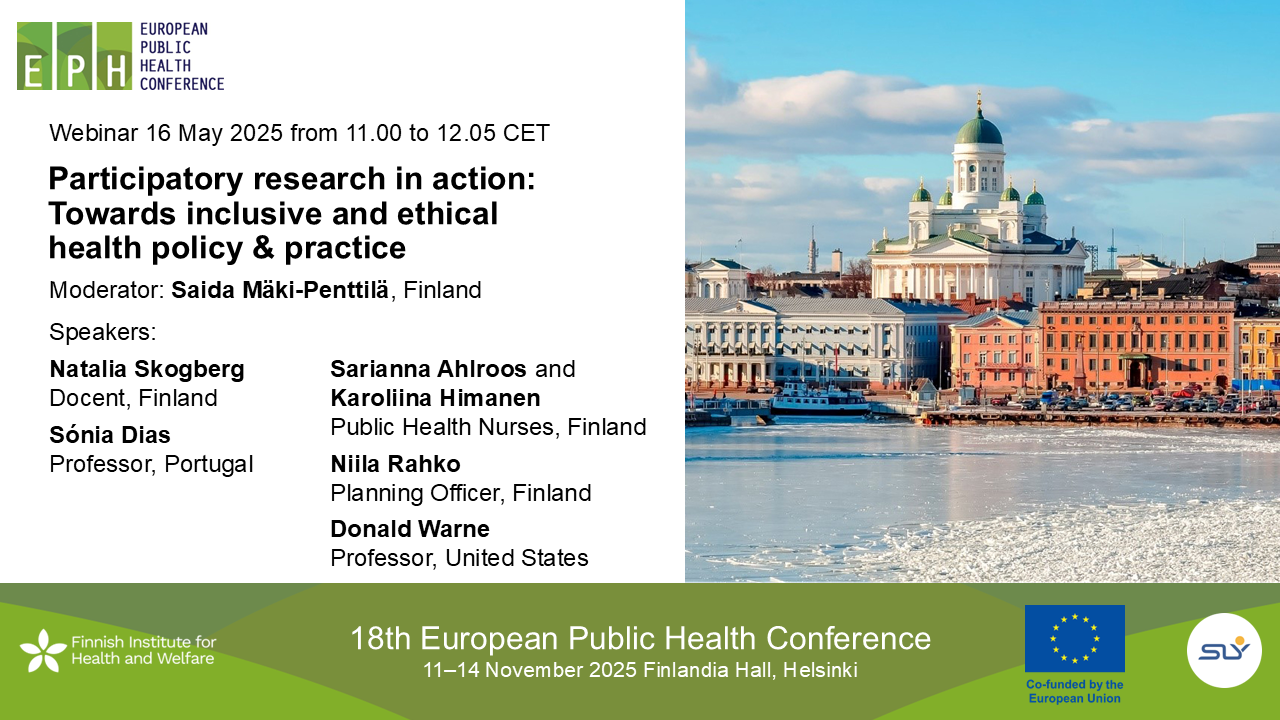
EPH2025 webinar series: Participatory research in action – 16 May
Save the date for the second webinar in the EPH2025 series: “Participatory research in action: Towards inclusive and ethical health policy & practice.”
Join us on Friday, 16 May, from 11:00 to 12:05 CEST on Microsoft Teams (no registration required). This session will explore how participatory research is driving more inclusive and ethical health systems, with a special focus on ethnic minorities and Indigenous peoples.
Speakers:
Moderated by Saida Mäki-Penttilä, Development Manager, Finnish Institute for Health and Welfare (THL), Finland.
EPH 2025 webinar series: first recording available now
The first webinar in the lead-up to the 18th European Public Health Conference in Helsinki has now taken place. Organised by the Finnish Institute for Health and Welfare (THL) and the Society for Social Medicine in Finland (SLY), this session explored the key theme, “Shifting the focus of health and economic policies: Investing for sustainable health and well-being.”
During the webinar, experts discussed the well-being economy, the role of EU policies, the economic value of investing in health, and future public health policy directions in Europe. If you missed the live session, the recording is now available. Watch the webinar here to catch up on this important discussion.
Stay tuned for future webinars in the EPH 2025 series as we continue to explore the themes leading up to the conference in November.
|
5. European Institutions’ news
Council of the European Union
14 April – Mental Health and Children in the Digital Age
10 April – Rare Diseases Conference in Warsaw
European Commission
24–30 April – European Immunisation Week
23 April – Pharmaceutical industry pushback
17 April – Stricter measures on Avian Influenza
16 April – Pandemic Agreement Progress Welcomed
16 April – Migration and Asylum Pact Advances
8 April – Read-out of the dialogue with the pharmaceutical industry
1 April – European Internal Security Strategy Unveiled
1 April – Questions on Cohesion Policy Legislation Answered
28 March – €1.3 Billion Investment in AI, Cybersecurity, and Digital Skills
26 March – EU Preparedness Strategy Released
European Parliament
9 April – SANT–FEMM Hearing on Chemical Safety
9 April – WHO Adviser Briefs Parliament on NCDs
2 April – 2026 EU Budget Priorities: Focus on Resilience
2 April – Democracy Under Pressure: Parliament Responds
|
6. Call for proposals, job opportunities
Postdoctoral Opportunity in Science Communication at the University of Zurich
The Department of Communication and Media Research (IKMZ) at the University of Zurich invites applications for a 3-year, 80% postdoctoral position in science communication, beginning 1 October 2025. The role is based in Zurich.
The successful candidate will engage in state-of-the-art research on science communication, lead individual and collaborative projects, publish in leading academic journals, present at conferences, and participate in public outreach. Applicants should hold a doctoral degree in communication science or a related discipline, with a strong record or interest in research on science communication, particularly on topics such as AI, climate change, or health. Applications must be submitted by 15 May 2025.
Click here for more information.
|
7. Upcoming courses and conferences
|
8. Interesting publications
From algorithms to negotiations: Why health diplomacy must adapt
Health diplomacy traditionally relies on consensus-building across nations, yet the accelerating integration of artificial intelligence (AI) into health systems poses new governance challenges. Rapidly changing geopolitical conditions—exemplified by shifts in U.S. global health funding and the expansion of AI beyond national boundaries—underscore the urgency of rethinking traditional approaches. This paper, based on insights from the Prince Mahidol Award Conference 2025 side meeting on “Navigating the Future: AI & Global Health Diplomacy,” examines how AI can reshape the practice of health diplomacy, both empowering and unsettling global health objectives.
Click here for more information.
Profiling misinformation susceptibility
The global spread of misinformation poses a serious threat to the functioning of societies worldwide. But who falls for it? In this study, 66,242 individuals from 24 countries completed the Misinformation Susceptibility Test (MIST) and indicated their self-perceived misinformation discernment ability. Multilevel modelling showed that Generation Z, non-male, less educated, and more conservative individuals were more vulnerable to misinformation.
Click here for more information.
Optimal dietary patterns for healthy aging
As the global population ages, it is critical to identify diets that, beyond preventing noncommunicable diseases, optimally promote healthy aging. Here, using longitudinal questionnaire data from the Nurses’ Health Study (1986–2016) and the Health Professionals Follow-Up Study (1986–2016), we examined the association of long-term adherence to eight dietary patterns and ultraprocessed food consumption with healthy aging, as assessed according to measures of cognitive, physical and mental health, as well as living to 70 years of age free of chronic diseases.
Click here for more information.
|
|
|
|
Unsubscribe
If you would like unsubscribe from the EUPHA newsletter then please click here.
|