 |
|
Context and purpose
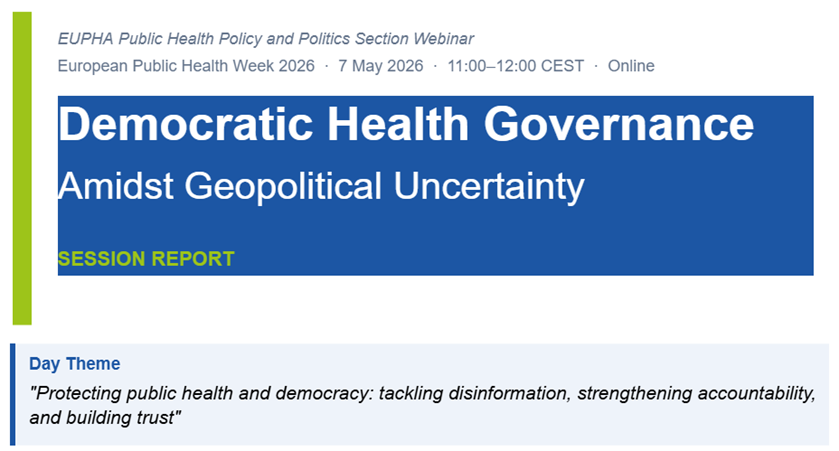
This webinar was organised by the EUPHA Public Health Policy and Politics Section (EUPHA PHPP) as part of European Public Health Week (EPH) 2026. The session explored how health governance is being reshaped amidst geopolitical uncertainty, declining institutional trust, democratic backsliding, disinformation and growing securitisation.
The central question was not only whether health receives more political attention post-COVID-19, but how it is governed – and whether current responses strengthen or undermine democratic values, human rights, public trust and global health equity.
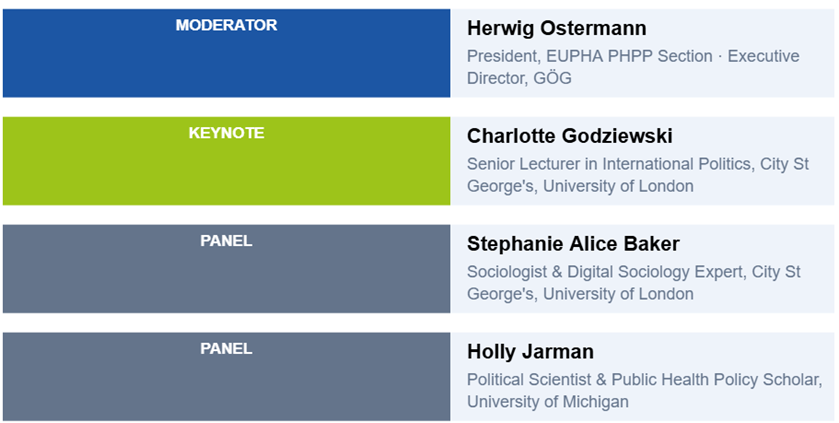
Speakers
KEYNOTE. HEALTH GOVERNANCE; SECURITISATION & DEMOCRATIC RISK
Godziewski opened by framing public health broadly — shaped by belonging, agency and meaningful participation. Her central argument: governance itself is a determinant of health. This includes not only policy outputs, but the quality of governance processes — who participates, how transparent decisions are, and whether people feel empowered.
She acknowledged that COVID-19 placed health high on policymaking agendas, including through the European Health Union. However, she argued that a quantitative increase in attention is insufficient. What matters is the qualitative character of health governance: whether policies protect democratic participation, transparency, accountability and equity.
Securitisation of Health
In a context of geopolitical uncertainty and supply chain vulnerabilities, health governance is increasingly framed through security and crisis logics. Godziewski warned that this can normalise exceptional measures – institutionalising speed, reducing consultation and limiting democratic deliberation. She illustrated this with the Critical Medicines Act, where the urgency of medicine shortages has been used to justify accelerated legislative procedures.
PANEL REFLEXTION: CULTURE, CREATORS & PLATFORM INFRASTURCTURES
Baker focused on the digital and cultural dimensions of trust. Three interlocking arguments:
Baker noted that misleading content no longer needs large followings to spread. Highly engaging content from micro-accounts can be amplified rapidly. She also introduced the concept of strategic silence: publicly criticising misinformation may unintentionally amplify it by increasing engagement.
PANEL REFLEXTION: DEMOCRATIC BACKSLIDING, POPULISM & PUBLIC HEALTH
Jarman described a negative feedback loop between poor health, social exclusion and support for right-wing populism: insecurity and neglect may increase receptiveness to populist narratives, while populist governance weakens healthcare, defunds public health infrastructure, undermines science and deepens exclusion — worsening the conditions for further mobilisation.
She stressed that the networks driving this dynamic operate internationally, involving economic actors, media interests and foreign agents. As responses, she highlighted:
AUDIENCE DISCUSSION
Algorithms, AI & echo chambers
Platform evolution has fundamentally changed health information circulation. Short-form video and algorithmic feeds can amplify misleading content rapidly, even from micro-accounts. Baker introduced strategic silence: publicly criticising misinformation may unintentionally increase engagement.
Using urgency for structural reform
Jarman drew on agenda-setting theory: structural problems persist until a crisis creates political visibility. She proposed combining advocacy on social and commercial determinants with a focus on political determinants of health — the institutional rules and power structures that shape whose voices are heard.
Crisis as political construction
Godziewski stressed that what counts as a crisis is politically constructed. Infectious disease outbreaks more easily generate urgency; inequalities and NCDs often lack the same political “crisis charisma”, even when their health effects are severe.
Breaking cycles of democratic erosion
Strategies highlighted included breaking up concentrations of power, exposing links between economic and political influence, and grassroots mobilisation. Baker drew on historical civil rights health activism as evidence that community-level trust can reframe health as a social and political question.
|
|
Unsubscribe
If you would like to unsubscribe from the section ‘Public health policy and politics’ please click here.
|