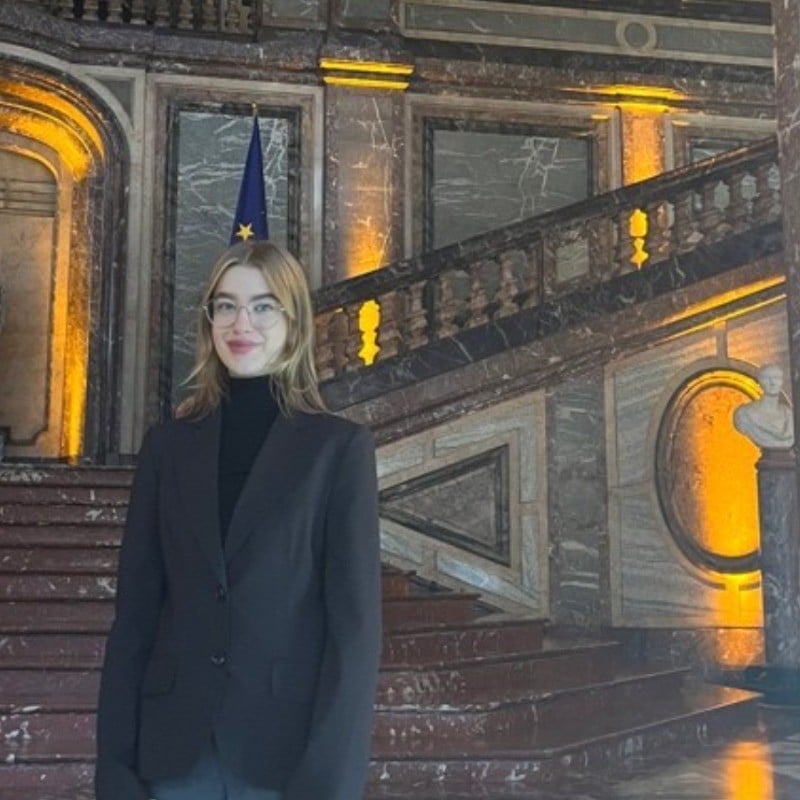
I am Wiktoria Bicka, a Polish student currently pursuing an MSc in International Health Policy at the London School of Economics. Before LSE, I studied Political Science with a minor in Global Health at the University of Amsterdam – a combination that has always reflected my conviction that health is never just a medical question. It is a political one.
Public health found me before I fully found it. Volunteering at a municipal social welfare centre as a teenager, I watched families navigate systems that were supposed to protect them but often failed to reach them. That gap between policy design and lived reality has never left me. It is what pushed me towards research, advocacy, and eventually to EUPHA.
For as long as I can remember, I have been drawn not just to research for its own sake, but to research that moves. Evidence that sits in journals and never reaches a decision-maker or a policy brief feels like an incomplete act. What I want & what I am working towards is a career in evidence-based policy analysis: being the person who ensures that what the data shows actually shapes what governments and institutions do. The Healthy Food Healthy Planet project offered something I had been searching for: the chance to examine how accountability for health and sustainability outcomes can be embedded into the systems that shape what people eat, and to do so in a way directly oriented towards policy audiences.
My tasks
My primary responsibility was conducting a structured literature review on regulatory policies that hold large food companies accountable for the health and sustainability impacts of their products – covering interventions like front-of-pack labelling, marketing restrictions, sugar taxes, and procurement standards. The work involved systematic database searches, critical appraisal of evidence, and translating complex findings into outputs that could genuinely inform policy stakeholders. What made this work meaningful was that it was not abstract. Every study I reviewed represented a real policy decision made somewhere in the world, with real consequences for real people.
If I am honest, the part of this internship that moved me most was not a methodology or a database. It was the people. Working within a European public health network means encountering perspectives you would never find in a single institution or a single country. I spoke with other researchers, practitioners and advocates across different systems and priorities. Each conversation (and online meeting) challenged something I thought I already understood. I came in confident in my analytical skills. I left realising that evidence, however rigorous, only travels as far as the relationships and trust that carry it. Learning from others, genuinely listening, not just absorbing, turned out to be the most professionally transformative thing I developed here. No methods course can fully teach that.
The hardest moments were the ones where the evidence pointed clearly in one direction, but the political and commercial realities pointed somewhere else entirely. Sitting with that tension, rather than resolving it too quickly, required a kind of intellectual patience I had to actively build. We already know what works. The remaining question is whether our systems are willing to measure it, enforce it and refuse to accept anything less.
How did this internship change me?
I arrived at EUPHA with a longstanding commitment to women’s health. Reproductive rights, maternal health, gender equity in care. I leave with something broader and more interconnected. Through this work on food systems and non-communicable diseases, I began to see the same structural forces at play: commercial interests that profit from harm, populations bearing disproportionate burden, and policy spaces that open and close with political will. Women bear a particular and often underdocumented burden in this story. They are more likely to manage household food decisions under constrained resources, to be targeted by marketing for nutritionally poor products, and to experience the compounding effects of poor food environments across reproductive life. The link between commercial food environments, NCD risk, and women’s health is structural. Understanding that has deepened my original passion and made me a sharper thinker about where I want to direct my career.
What is my advice for future interns?
Whatever stage you are at, however many papers you have read, however many projects you have worked on, come ready to be surprised. Step outside what is comfortable. Be genuinely curious about the people around you. The knowledge in a network like EUPHA does not live only in documents. It lives in the people who have spent years building it, and they are generous with it, if you ask.
A Note of Gratitude
None of this growth would have happened without the people who made this internship what it was. To Julian Hein – my supervisor, and one of the most intellectually generous people I have had the privilege of learning from. Working alongside Julian taught me what critical thinking looks like in practice: not as a technique, but a genuine commitment to asking harder questions, sitting with complexity, and never letting rigour become an excuse for distance from the real world. I am deeply, genuinely grateful for his guidance, his patience, and his belief in this work. To Charlotte Marchandise, for showing me, by example, that you must always push for what you believe in. Charlotte’s leadership made clear that public health is not just a professional field; it is a moral commitment, and one worth defending with everything you have! And to the entire team – Monica, Natalie, José, Nic, and Jennie – thank you. Being a young professional is not easy. But this team showed me what it looks like when people choose warmth over hierarchy and support over competition.