 |
The European Public Health Association Newsletter – January 2026 |
|
Newsletter – January 2026
|
1. Editorial
Editorial | EUPHA in 2026: from ambition to action
2026 is not about doing more. It’s about doing what matters.
EUPHA enters this year with a clear direction. Our 2025–2030 strategy sets the ambition. Now our task is to turn that ambition into action that members can see, use, and feel.
Earlier this month, the EUPHA team came together for a strategy retreat to set our priorities and work plan for 2026. We challenged ourselves on what truly matters, where we can have the greatest impact, and how we grow in a smart and sustainable way. That work is now shaping everything you will see from us this year.
You will notice three things in 2026.
First, more focus.
Second, stronger connection with our community.
Third, action on the issues that matter most.
You will see this in practical ways:
EUPHA is a small team, but we work with a big network. What we achieve in 2026 will depend not just on our plans, but on how we work together — members, Sections, partners, collaborators, and staff. This year is about momentum, building on what works, fixing what doesn’t, and staying focused on impact.
We’re glad you’re part of it — whether you engage with EUPHA as a member, partner, or part of the wider public health community.
Dr. Tit Albreht, EUPHA President
|
2. EUPHA news
Upcoming EUPHA Section webinars
Our Sections continue to bring together experts from across Europe and beyond to explore today’s most pressing public health challenges. Join us to stay informed, share knowledge, and connect with the latest research and policy developments.
26 February 2026, 16:00 – 17:00 CET
Organizer: Chronic Diseases Section
This webinar will examine how oral health connects to broader public health outcomes and why it deserves greater attention in policy and practice. The webinar will be delivered by Dr. Paula Vassallo, who will share insights from research and practice, followed by a discussion.
Upcoming EUPHA Section mid-term conferences in 2026
Several EUPHA Sections are hosting mid-term conferences in 2026, bringing together researchers, practitioners, and policymakers to exchange evidence, strengthen collaboration, and tackle pressing public health challenges.
23–24 April 2026 | Cluj-Napoca, Romania
The Health and Care Workforce Section will host its 2026 mid-term conference in Cluj-Napoca, focusing on current and emerging challenges affecting the health and care workforce across Europe.
The conference will provide a platform to share research, policy insights, and practical experiences related to workforce planning, sustainability, skills development, and working conditions in health and care systems.
Why attend?
Pre-registration is now open. By signing up, participants will receive conference updates and early information on registration.
3–4 June 2026 | Copenhagen
This two-day symposium, organized by the EUPHA Chronic Diseases Section together with national and international partners, will explore how knowledge on multimorbidity can be translated into real-world prevention, care, and policy.
The programme is structured across three thematic sessions:
Danish and international experts will lead keynote talks and discussions. A dedicated session of short presentations from up to ten participants is also planned (sign-up details to be announced).
Format and practical details
Save the dates and keep an eye on upcoming registration announcements to take part in these important Section-led exchanges.
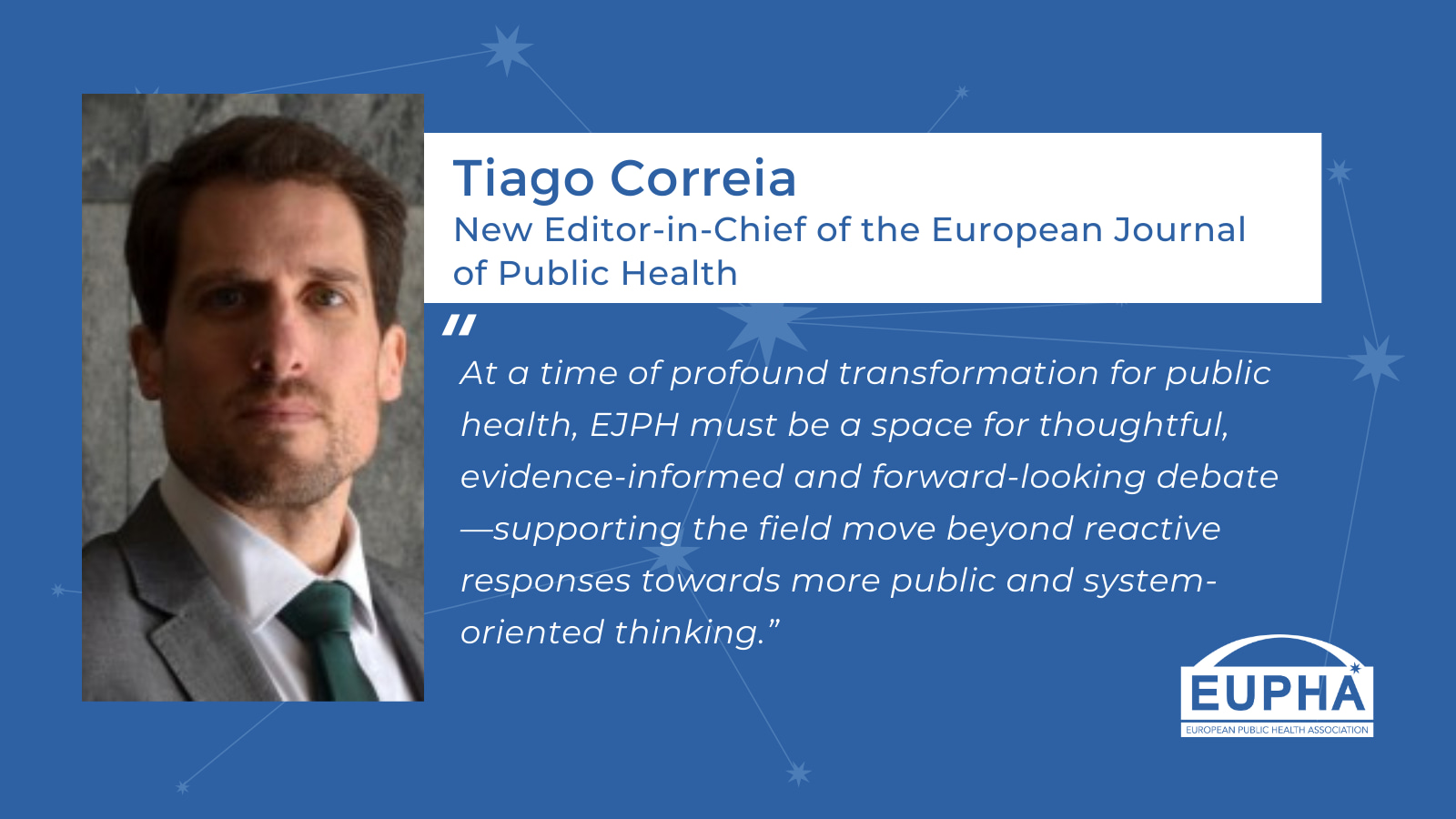
Tiago Correia appointed Editor-in-Chief of the European Journal of Public Health
We are pleased to announce the appointment of Tiago Correia as the new Editor-in-Chief of the European Journal of Public Health (EJPH), EUPHA’s scientific journal.
Tiago is Associate Professor of Global Public Health at the Institute of Hygiene and Tropical Medicine, Universidade NOVA de Lisboa (Portugal), with extensive experience at the intersection of public health research, policy, and practice. As Editor-in-Chief, he aims to strengthen EJPH’s role in publishing high-quality, policy-relevant research and to deepen links with the European Public Health Association community.
Read the full article and learn more about Tiago’s vision for EJPH.
EUPHA launches Behavioural and Social Science Section
We have officially launched the Behavioural and Social Science Section, a new thematic network focused on strengthening the role of behavioural and social sciences in public health research, policy, and practice across Europe.
The Section will promote interdisciplinary collaboration, support training and capacity building, and work with partners and other EUPHA Sections to embed behavioural perspectives across public health domains. Its aim is to help translate behavioural insights into more effective interventions, policies, and communication strategies.
Public health professionals interested in contributing to or learning from the Section’s work are invited to join the network and follow upcoming activities and resources.
Ethics, values, and law for public health in a world in turmoil
EUPHA, in collaboration with the Global Network for Academic Public Health and other partners, has supported the publication of a special supplement on ethics, values, and law for public health in a world in turmoil.
The supplement highlights that we are at an inflection point in history, with a crisis of trust and legitimacy in public health, with growing turbulent geopolitical influences, significantly impacting on public’s health, such as climate change, resulting in moral distress and injury to the public health workforce. The publication calls for renewed reflection on the mission, values, and mandate of public health, and for standing in solidarity to protect and advance the public’s health and well-being.
Building on this work, the EUPHA Ethics in Public Health Section plans a series of activities to create space for reflection and discussion on the issues raised, as well as their implications for public health policy and practice. Those interested in contributing ideas or engaging with this agenda are invited to get in touch. Please contact Farhang Tahzib, President of the Ethics in Public Health Section via [email protected]
EUPHA Section contributes to HTAi webinar and launch of new HTA awareness video
Experts from the Health Technology Assessment Section recently contributed to a webinar organised by the Public Health Interest Group of Health Technology Assessment international, focused on the role of health technology assessment (HTA) in supporting public health decision-making.
The webinar also marked the launch of a new HTA and public health awareness video, now available on YouTube in multiple languages, including English, French, Spanish, Arabic, and Chinese. The video aims to explain the value of HTA for public health policy and practice across different regions and contexts.
This collaboration highlights the active involvement of EUPHA Sections in international dialogue and knowledge exchange, contributing public health expertise to global discussions on evidence-informed decision-making. Readers are encouraged to watch and share the video within their networks to help raise awareness of the role of HTA in improving public health outcomes.
|

3. European Public Health Conference
Get ready to submit your work to the 19th EPH Conference
Preparation is underway for the 19th EPH Conference, and now is the time to start thinking about what you may want to submit.
The upcoming call for abstracts will invite contributions across multiple formats, including workshops, oral presentations, pitch presentations, and ePosters. As in previous editions, sessions will provide a platform to share research, policy insights, and practice-based experience with a diverse European and international public health audience.
Whether you are planning to present new research, showcase innovative practice, or convene discussion around an emerging issue, early preparation can help strengthen your submission and collaborations.
This year, abstracts will be submitted through a new submission system, designed to support a more intuitive, efficient, and user-friendly process, aligned with the evolving EPH Conference experience.
Further details on abstract submission timelines and requirements will be shared soon.
A new EPH Conference website is coming soon
EPH Conference will soon launch a new website designed to improve the experience for participants, partners, and contributors across the full conference journey. The new site is being developed with a stronger user focus, making it easier to find key information, navigate important deadlines, and engage with conference content before, during, and after the event.
What to expect
The website will launch next month, with further details and links shared soon. We look forward to welcoming you to a more intuitive and user-friendly EPH Conference digital home.
|
4. Call for proposals, job opportunities
New CFO role at EUPHA — apply by 21 February 2026
EUPHA is recruiting a Chief Financial Officer (CFO) based in Utrecht to lead the financial management and administration of both EUPHA and the EPH Conference. This part-time (24–32 hours/week) role reports to the Executive Director and works closely with the Deputy Director, providing strategic financial advice, overseeing budgeting, reporting and compliance, and supervising the finance officer.
The successful candidate will have senior finance and administration experience, strong strategic insight, and fluency in Dutch and English, along with knowledge of Dutch regulations and project finance (especially EU grant-funded work). The position offers a competitive salary (€5,000–€5,800 gross on a full-time basis) with benefits and a hybrid working arrangement.
Deadline: 21 February 2026
|
5. Upcoming courses and conferences
|
6. Interesting publications
How to communicate evidence against catchy erroneous arguments?
In a workshop at the European Public Health conference 2025, the authors deployed a forum theatre alongside traditional presentations to examine the ability of public health professionals to communicate evidence informed, practical messages that foreground protecting public health and to convince a public health audience to support them. Participants were asked to intervene as participators in a staged debate between pro-WHO and anti-WHO politicians in a fictional parliament. The pro-WHO side used evidence-based arguments, whereas the anti-WHO side used misinformation and populist arguments, claiming that WHO is distant, politicised, unaccountable, hides information from ‘ordinary people’, suggesting that national sovereignty should replace global cooperation and multilateral governance. These inaccurate arguments were deliberately framed to evoke identity, frustration, and distrust—features known to increase persuasive power and limit scrutiny of the underpinning arguments
Health inequalities tackled through intersectoral collaboration: longitudinal process issues and insights
This study contributes to ongoing reflections and debate on the legacy of the Ottawa Charter by illustrating how contemporary forms of intersectoral collaboration can be mobilized to address persistent health inequalities. Collaborations involving organizations from diverse sectors are often viewed as well-positioned to tackle complex health challenges, yet they frequently encounter political, organizational and cultural barriers that hinder their effectiveness. This paper uses a longitudinal approach to explore issues in relation to the formation and sustainability of a multi-sector collaboration in one geographic area in the UK, working under the banner of the Health Determinants Research Collaboration (HDRC)—a programme which seeks to further understand health determinants and to improve health outcomes in communities.
Reclaiming trust: public health action to counter the infodemic
Effective communication is at the heart of public health action, and this became apparent in the pandemic. Whether we were advising on isolation, promoting safe environments, or leading vaccination campaigns, our success depended on effective engagement with those involved and affected. Only in exceptional circumstances can we mandate people to act in a certain way. Instead, we inform, encourage, and in some cases warn people to adopt healthy or risk-reducing behaviours, often for them as individuals but sometimes also for those around them. This communication is two-way: understanding the health needs of those we serve and offering solutions based on evidence.
|
|
Unsubscribe
If you would like unsubscribe from the EUPHA newsletter then please click here.
|